The Bob Iger Method: How to Save Your Annual Planning Strategy
Haven’t done your annual planning yet? Start now with Disney CEO Bob Iger’s "Simple, Ruthless, Clear" method to set priorities that actually work.

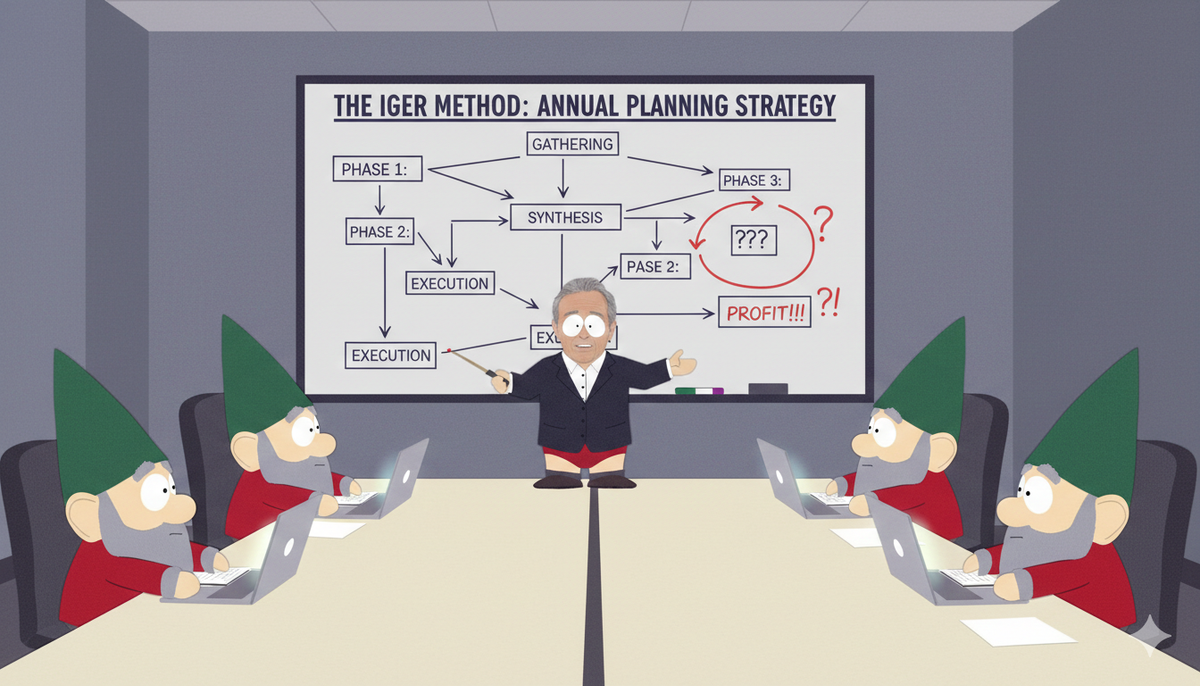
It happens every year. January arrives, the holidays fade, and a mild panic sets in:
We haven’t finished the annual plan.
If you are staring at a blank calendar or, worse, a roadmap filled with clutter but devoid of direction, you might feel like you are already behind. But you aren’t. In fact, starting late is better than starting wrong.
You don't need a complex 50-page slide deck to get back on track. You need what legendary Disney CEO Bob Iger calls "The Essence of Strategy."
Simple. Ruthless. Clear.
Here is how to apply Iger’s approach to your annual planning using an OKR mindset, ensuring you finish the year ahead, even if you start on January 15th.
1. Start with the Ending (The Objective)
Most teams start planning by looking at their to-do lists. They ask, "What do we need to do?"
Bob Iger flips the script. He starts with the ending. His primary question for any major initiative?
This is the difference between activity and outcome.
- Activity: "Launch three new marketing campaigns."
- Outcome: "Become the primary market leader in the EMEA region."
The Fix:
Stop listing tasks. Define the destination. In OKR terms, this is your Objective. It shouldn't be a vanity metric; it should represent a fundamental shift in the business topology. If you can’t visualize the ending, you can’t plan the journey.
2. Pick 3 to 5 Company-Shaping Priorities
In his masterclass on leadership, Iger famously stated that one of the most important qualities of a leader is "Focus."
"It is imperative that you communicate your priorities clearly and repeatedly... If you don’t do this, the people around you don’t know what to focus on. Time and energy and capital get wasted." — Bob Iger
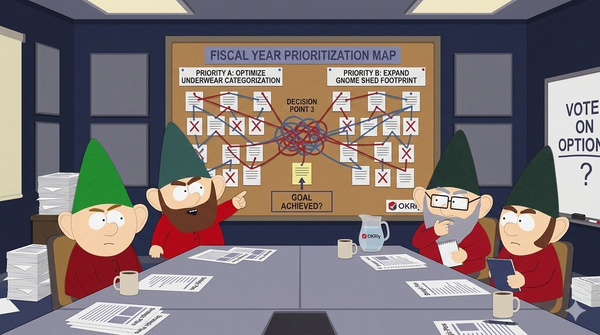
Many companies fail because they have 20 priorities. If you have 20 priorities, you have zero.
The Fix:
Be ruthless. Pick 3 to 5 initiatives that will truly bend the trajectory of the company.
- If an initiative doesn’t reinforce one of these 3-5 pillars, it gets cut.
- If a Key Result doesn’t measure progress toward one of these pillars, it gets deleted.
This constraints-based approach forces you to make trade-offs now, rather than making them accidentally in November when you run out of cash or morale.
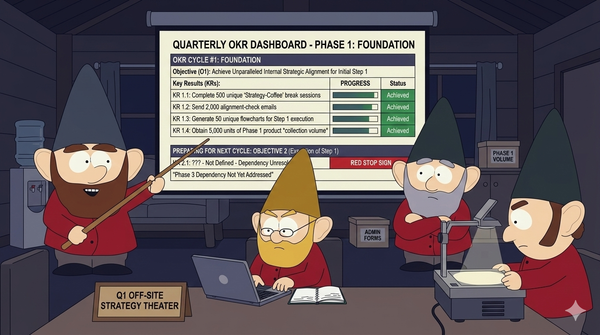
3. Turn the Year into a Rhythm (The Cadence)
A year isn’t a plan; it’s a sequence of opportunities.
A common mistake in annual planning is treating the year as a flat timeline. Iger and other top operators view the year as a narrative arc. At OKRly, we believe this translates perfectly into quarterly cycles:
- Q1: Momentum. Launch the new priorities. Validate hypotheses.
- Q2: Correction. Double down on what worked in Q1, kill what didn't.
- Q3: The Big Bets. This is where the heavy lifting lands, fueled by Q1/Q2 learnings.
- Q4: Closing the Arc. Finalize results and reset for the next cycle.
The Fix:
Don’t plan 12 months of tasks. Plan 12 months of focus, but execute in 3-month sprints. This allows you to remain agile. If the market shifts in March, your "Annual Plan" doesn't become a suicide pact; it evolves because your rhythm allows for adjustment.
Summary: It’s Not About Working Harder
Strategic planning is not about filling every hour of the employees' day with work. It is about seeing clearly.
By adopting Iger’s specific brand of ruthless simplification, you clarify the signal amidst the noise. Whether you are running a global media empire or a growing SaaS startup, the rules remain the same:
- Define the Outcome (Not the tasks).
- Limit the Focus (3-5 priorities only).
- Establish the Rhythm (Quarterly execution).
If you do this, you can start your planning in mid-January and still beat the competition who started in October but got lost in the weeds.
Frequently Asked Questions (Strategic Planning & OKRs)
What is the difference between Annual Planning and OKRs?
Annual planning sets the "North Star" or long-term vision for the year. OKRs (Objectives and Key Results) are the execution framework used to break that annual plan into actionable, quarterly sprints.
How many strategic priorities should a company have?
Following the Bob Iger method and standard OKR best practices, a company should have no more than 3 to 5 high-level priorities at a time. Anything more dilutes focus and resources.
Can I start annual planning in January?
Yes. While Q4 is ideal, starting in January allows you to use fresh year-end data to inform decisions. The key is to move quickly using a framework like "Simple, Ruthless, Clear" to avoid "analysis paralysis."
Need help visualizing your year?
We are building a tool that forces this level of clarity.
Drop a comment below if you want the Annual Planning Template based on this methodology. If there is enough demand, we might just turn it into a free app.
FAQ
What is the Bob Iger approach to strategic planning?
Iger's approach focused on identifying a small number of strategic priorities and committing to them fully. At Disney, he identified three: great content, technology, and globalization. Everything the company did was evaluated against these three priorities. The power was in the constraint — not three priorities among many, but three priorities instead of many. Every acquisition, every investment, every org change was filtered through those three lenses.
How do you apply this approach to annual planning?
Start by naming your three strategic priorities for the year. Then test every initiative, project, and budget line against them. If something doesn't clearly serve one of the three, it either gets cut or explicitly labeled as maintenance. This doesn't mean you only work on three things — it means the three priorities get the best resources, the most executive attention, and the first claim on any contested capacity.
What if leadership can't agree on just three priorities?
Then you haven't finished the strategic conversation. More than three priorities at the company level means you're trying to avoid the hard trade-offs. Run each proposed priority through a cost-of-delay analysis: what's the concrete cost of deferring this by one year? The priorities with the highest cost of delay should rise to the top. The rest are important but not strategic.
Want to Learn More?
Great annual planning starts with fewer priorities, not more. OKRly.ai helps you focus on what matters by tracking a tight set of OKRs against clear strategic priorities — so your annual plan becomes an operating system, not a wish list.