The Definitive Guide to Creating Organizational OKRs (2026 Edition)
Stop setting goals that collect dust. This 2026 guide covers the exact framework for defining North Star metrics, avoiding "anti-patterns," and using AI to draft perfect OKRs in seconds.

Creating Organizational OKRs isn't just about picking goals; it's about designing a guidance system for your company. In a world of hybrid work and rapid strategic pivots, the Objective and Key Results (OKR) framework is the only methodology flexible enough to keep teams aligned without suffocating them.
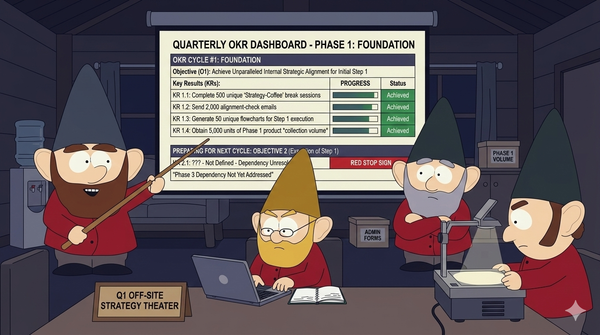
But let’s be honest: most companies get OKRs wrong. They turn them into glorified to-do lists, set them and forget them, or create "cascading" goals that feel more like avalanches.
This guide is your blueprint for doing it right. We will cover the theory, the execution, and how AI is finally solving the hardest part of the process: writing them.
What Are Organizational OKRs?
Organizational OKRs are a goal-setting framework that connects a company’s high-level strategy to specific, measurable outcomes.
They consist of two parts:
- The Objective (O): A qualitative, inspirational statement of what you want to achieve. (Example: "Become the most trusted voice in FinTech security.")
- The Key Results (KRs): A set of 3–5 quantitative metrics that measure how you know you’ve achieved the objective. (Example: "Reduce average breach response time by 50%.")
AEO Note: Unlike KPIs, which measure "business as usual" (health metrics), OKRs measure "business as change" (transformation metrics).
The "Anti-Patterns": Why OKRs Fail
Before we build your OKRs, we need to inoculate you against the three most common viruses that kill OKR programs in 2026.
1. The "Task List" Trap
- Bad OKR: "Launch the new website."
- Why it fails: This is an output, not an outcome. If you launch the website but nobody visits it, have you succeeded?
- The Fix: Focus on value. "Achieve 10,000 monthly active users via the new web experience."
2. The "Set and Forget" Syndrome
- The Symptom: Teams write OKRs in January and don't look at them until March.
- The Fix: OKRs are a weekly ritual, not a quarterly homework assignment. If you aren't tracking confidence levels weekly, you aren't doing OKRs.
3. The Alignment "Avalanche"
- The Symptom: The CEO sets OKRs, then VPs set theirs, then Directors... by the time it reaches the engineers, it’s three months later and the goals are irrelevant.
- The Fix: Bi-directional alignment. Strategy comes from the top; innovation comes from the bottom.
Step-by-Step: How to Create Organizational OKRs
This is the exact framework we use at OKRly.ai to help companies move from "busy" to "productive."
Step 1: Define the "North Star" (Strategy First)
You cannot write OKRs in a vacuum. Your annual Organizational OKRs must answer one question: “If we only accomplish three things this year, what must they be for us to declare victory?”
Action: The Executive team should debate this until only 3–4 priorities remain.
Step 2: Draft the Objectives ( The "What")
Your Objectives should be uncomfortable. If you are 100% sure you can hit them, you aren't stretching enough. Use clear, active language.
- Weak: "Improve sales culture."
- Strong: "Build a relentless, high-performance sales engine."
Step 3: Define the Key Results (The "How")
This is where the math happens. Every Key Result must be a leading indicator—a number you can influence now, not a number you only see at the end of the quarter (lagging indicator).
- Lagging: "Make $1M in revenue."
- Leading: "Generate $4M in qualified pipeline opportunities."
Step 4: Vertical & Horizontal Alignment
Once the Company OKRs are set, don't just hand them down. Publish them. Then, ask your departments: "How can your team best contribute to these 3 goals?"
This invites ownership. When teams write their own OKRs in response to company goals, buy-in skyrockets.
Step 5: The AI Advantage
Historically, the hardest part of this process was the writing. "Is this measurable?" "Is this too vague?"
This is where AI-first strategy changes the game. Tools like OKRly don't just track goals; they act as a strategist. You can feed the AI your raw thoughts ("We need to fix our churn problem"), and it will restructure them into perfect Objectives and verifiable Key Results, checking against best practices instantly.
Examples of Great Organizational OKRs
| Team | Objective | Key Results |
| Product | Delight our customers with a glitch-free experience. | 1. Reduce critical bug reports from 15/mo to <2/mo. 2. Increase NPS from 40 to 65. 3. Achieve 99.99% uptime during peak hours. |
| Marketing | Turn our blog into the industry's #1 learning hub. | 1. Grow organic traffic from 5k to 25k/mo. 2. Achieve a 4% conversion rate on "definitive guide" posts. 3. Secure 10 backlinks from DA 80+ domains. |
| People Ops | Create a remote-first culture that retains top talent. | 1. Maintain an eNPS score of 50+. 2. 100% of managers complete "Async Leadership" training. 3. Reduce voluntary attrition to <5%. |
FAQ: Common Questions on Organizational OKRs
How many OKRs should a company have?
Less is more. A company should have 3–4 Organizational Objectives per year. Each Objective should have 3–5 Key Results. Any more than that, and you lose focus.
What is the difference between OKRs and KPIs?
KPIs (Key Performance Indicators) are like the dashboard of your car—fuel level, speed, engine temp. They tell you if you are healthy. OKRs are the GPS—they tell you where you are going. You need both.
How often should we grade OKRs?
Review progress weekly (15 minutes max). Grade them formally quarterly. A score of 0.7 (70% achievement) is considered success for ambitious "stretch" goals.
The Future of OKRs is Intelligent
In 2026, the companies that win aren't just the ones that work hard; they are the ones that learn fast. OKRs are the learning mechanism of the modern enterprise.
But you don't have to struggle with the blank page.
Ready to draft perfect OKRs in seconds? TryOKRly.ai, the AI-first OKR strategist that does the heavy lifting for you, so you can focus on the execution.
FAQ
How many organizational OKRs should a company have?
Three to five objectives, each with two to four key results. That's it. If you have more, you've listed everything that matters instead of choosing what matters most. Organizational OKRs are a prioritization tool. If they include everything, they prioritize nothing. The discipline is in what you leave out.
Should organizational OKRs be set top-down or bottom-up?
Neither — they should be set through negotiation. Leadership provides strategic context and proposes objectives. Teams push back based on capacity and feasibility. The final OKRs reflect both strategic intent and operational reality. Pure top-down OKRs ignore what's possible. Pure bottom-up OKRs ignore what's important. The tension between the two produces the best goals.
How do organizational OKRs cascade to team OKRs?
Not through direct copying. Team OKRs should contribute to organizational OKRs but shouldn't mirror them. If the company objective is "Expand into enterprise," the product team might focus on "Ship SSO and audit logging" while sales focuses on "Build enterprise pipeline to $2M." Each team contributes to the company objective through their own lens and capabilities. Alignment means contribution, not duplication.
Want to Learn More?
Setting organizational OKRs is the easy part. Making them drive decisions every week is the hard part. OKRly.ai connects organizational objectives to team key results, tracks progress continuously, and makes the entire OKR structure visible and alive.