How to Introduce an OKR Framework to Your CEO When They Don't Want It
Most CEOs resist formal goal‑setting frameworks until they see them work. This article explains how to introduce OKRs gradually - start with simple quarterly goals, demonstrate clarity, and build buy‑in through visible success. Gradual change drives lasting adoption.

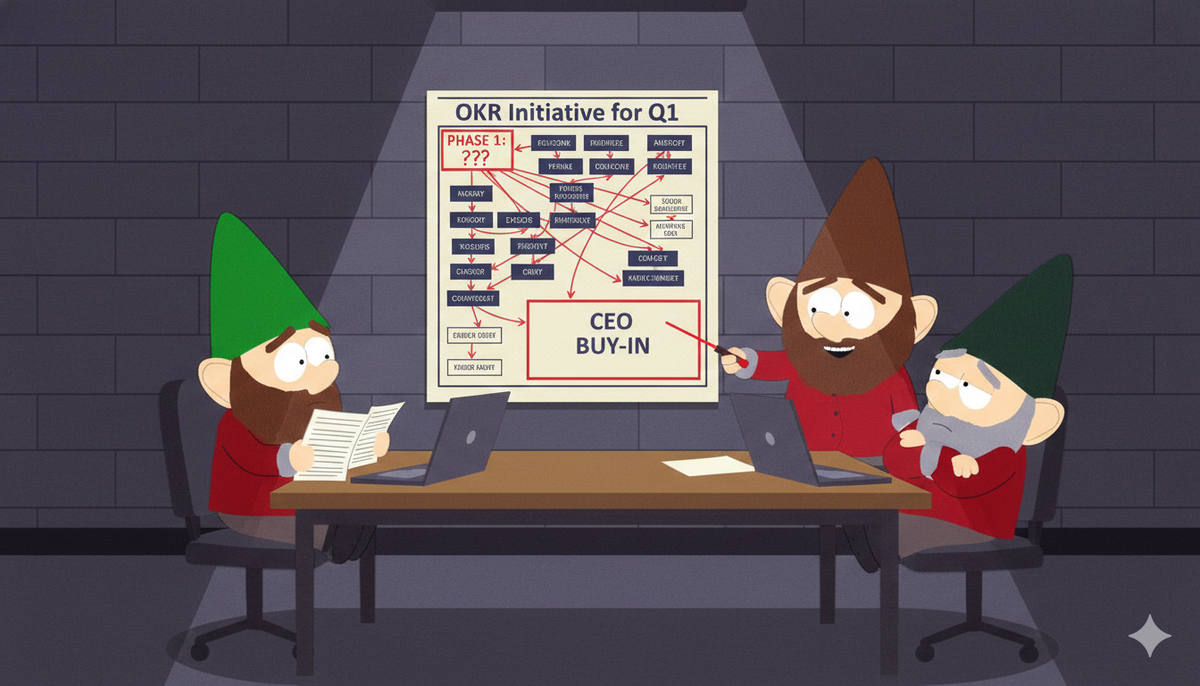
“I want to introduce a goal‑setting framework, but my CEO doesn’t believe in them. We need it, though. How do I do it?”
I get this question a lot.
The answer is one word: gradually.
It may not sound like the silver bullet you wanted, but it actually is.
Here’s why.
When you’re operating at a leadership level, you learn quickly that you can’t drag people to where you are. You’ve been thinking about the framework for weeks. You’ve gone from zero to one to one hundred in your head.
Your team is still at negative one hundred.
You have to meet them where they are and bring them forward at a pace they can absorb.
Change takes time. And no matter how beneficial you think the change will be, people hate change at first, and maybe at second, and maybe at third. But they get there once they feel the gain.
So what does this mean for your push to introduce goal setting?
It’s still the same word: gradually.
Do not roll out OKRs across the whole org unless your CEO is on board and bullish. That’s the only scenario where it works.
Start small.
Ask your CEO to set three simple quarterly goals. Not OKRs. Just goals.
One for revenue.
One for product.
One for ops.
You can frame it simply:
“We can’t get to where you want the company to be next quarter if we don’t know where you want it to be. Let’s set three goals to start.”
Quarterly instead of annual because you probably won’t hit them at first. But you’ll be directionally right, and that’s how clarity begins.
And clarity is something every company needs.
For the ops goal, use OKRs.
Show how the structure helps you deliver results.
When you hit your goal and others don’t, you’ve created the perfect proof point.
Nothing sells change like simultaneous success and failure.
So I’ll say it again: the key is gradually.
It takes patience, which is hard in a fast‑moving, high‑stakes environment. But the more you push something the body isn’t ready for, the more it rejects it.
Play the long game.
Bring people to where you are gradually.
Ready to make OKRs actually work?
Try OKRly, the AI‑first OKR strategist that does the heavy lifting for you.
https://okrly.ai
FAQ
Why do some CEOs resist OKRs?
Usually because they've seen OKRs implemented badly — as bureaucratic overhead that generates spreadsheets instead of results. Their skepticism is often earned. The way to overcome it isn't to argue that OKRs work in theory. It's to show a small, concrete example of OKRs working in practice. Run a quiet pilot with one team, generate real results, and let the evidence make the argument.
How do you run an OKR pilot without CEO buy-in?
Pick one team you manage directly. Set three measurable key results for the quarter. Run weekly check-ins focused on those key results. At the end of the quarter, present two things to the CEO: the results the team achieved and the specific decisions the OKR framework helped you make. Don't pitch "OKRs" — pitch "here's how we improved execution, and here's the lightweight system we used."
What if the CEO says OKRs are too rigid?
They might be right — for their previous experience with OKRs. Emphasize that OKRs done well are a flexible framework, not a rigid process. Key results can be adjusted mid-quarter if the situation changes. The cadence can be lightweight. The format can adapt. Show them the minimal viable version: three objectives, nine key results, a 15-minute weekly check-in. If that feels too rigid, the problem isn't the framework.
Want to Learn More?
You don't need CEO buy-in to start. You need results. OKRly.ai is the lightweight OKR system that makes the framework easy to adopt — start with one team, show the results, and let execution speak for itself.