Confessions of a COO: The Real Reasons OKRs Fail
I’ve been a COO at multiple public and private companies. I believe in OKRs, but I also know why they rot. It's not because teams don't "get it." It's because leaders avoid the tradeoffs.

A little bit ago, we published The Definitive Guide to Creating Organizational OKRs.
It did what it was supposed to do. It explained OKRs clearly. It laid out best practices. It avoided the usual nonsense.
But if I’m honest, it still pulled a punch.
This post is the part you usually don’t get. This is the version you only hear after the board meeting, or in a one-on-one with a COO who’s seen this break more than once.
I’ve been a COO at multiple companies—public and private—at different stages, with different founders, boards, and cultures. I believe in OKRs. I also know exactly why they fail.
This is that truth.
The First Thing to Understand: It’s Not a Comprehension Problem
OKRs don’t fail because teams don’t get them.
Most teams understand OKRs just fine. They know the definitions. They can recite the rules. They can even write decent Objectives and Key Results.
OKRs fail because they surface tradeoffs leaders don’t want to make.
They force clarity where ambiguity is politically useful. They expose conflicts between growth, quality, and morale. They reveal that not everything matters equally.
That’s the real problem. If your leadership team is unwilling to say "no," OKRs will quietly rot.
Brutal Truth #1: If Everything Is a Priority, You Don’t Have OKRs
This is the most common failure mode I’ve seen.
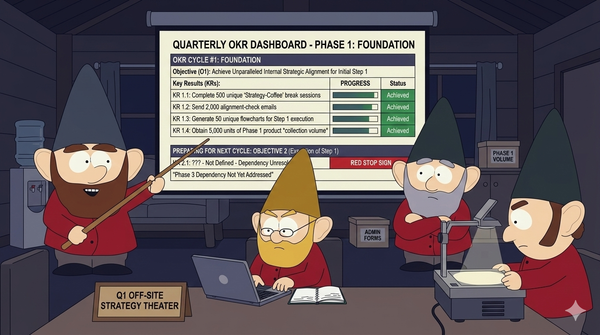
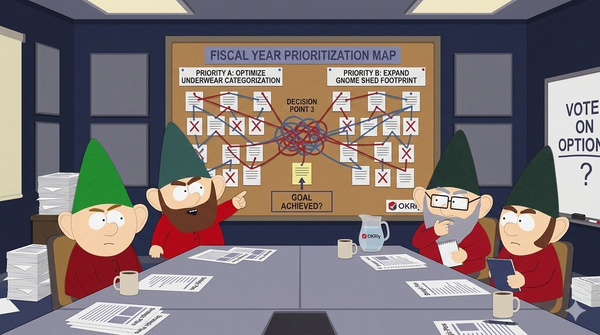
The executive team agrees on OKRs in theory. Then, everyone sneaks their “one more thing” back in.
- Product gets five objectives.
- Sales gets six.
- Marketing gets “brand,” “pipeline,” and “experiments.”
On paper, it looks aligned. In reality, no one is choosing.
The Reality Check: OKRs only work when they hurt a little. If no one is uncomfortable with what didn't make the list, you’re lying to yourselves.
Brutal Truth #2: Comp Plans Kill More OKRs Than Bad Writing Ever Will
No one wants to talk about this. But it matters.
If someone’s compensation is tied to a metric that conflicts with the OKRs, the OKRs will lose every time. Always.
You can’t ask a leader to optimize for churn reduction if their bonus is driven exclusively by top-line growth. You can’t ask a team to slow down for quality if speed is how they’re rewarded.
People aren’t irrational. They’re responding to incentives. If OKRs and compensation are misaligned, OKRs become theater.
Brutal Truth #3: Weekly Cadence Is Not Optional
This one separates adults from children.
OKRs are not a quarterly planning artifact. They are a weekly operating system.
If you’re not reviewing progress weekly—briefly, consistently, and without drama—you are not running OKRs. You’re doing goal cosplay.
What happens in most companies:
- January: OKRs are written.
- February: Everyone’s busy.
- March: Surprise and disappointment.
That’s not a tooling problem. That’s a leadership discipline problem.
Brutal Truth #4: Cascading Is Where Good Intentions Go to Die
Top-down "cascading" sounds clean. In practice, it’s slow, brittle, and usually wrong by the time it lands.
If your OKR process feels like an org chart flowing downhill, you’ve already lost buy-in.
Here’s what actually works:
- Strategy is set at the top.
- Constraints are made explicit.
- Teams respond with how they will contribute.
Alignment is a conversation, not a handoff.
Brutal Truth #5: Hitting 100% Is Often a Failure Signal
This surprises people. If teams consistently hit 100% of their OKRs, one of three things is true:
- The goals weren’t ambitious.
- The metrics were sandbagged.
- The work didn’t matter as much as you thought.
Healthy OKRs usually land around 60% to 80%. That range tells you you’re stretching without breaking. Anything else is noise.
The Part Most Guides Don’t Say Out Loud
OKRs are a Mirror.
They don’t just show you what your company is working on. They show you:
- Where you avoid conflict.
- Where incentives are broken.
- Where trust is thin.
- Where leadership clarity stops.
That’s why OKRs feel heavy in some organizations. They’re not exposing execution problems. They’re exposing leadership ones.
Where AI Actually Changes the Game
Let’s be clear about something. AI does not magically make strategy good. It does not replace judgment. It does not remove the need for hard conversations.
What AI does is close the execution gap humans reliably leave open.
In every company I’ve worked with, the breakdown happens between Monday and Friday:
- Updates don’t get written.
- Risks don’t get surfaced early.
- Context gets lost.
- Leaders are surprised too late.
This is why we built OKRly. It changes the dynamic by remembering context humans drop, forcing weekly reflection without nagging, and surfacing drift before it becomes failure.
It acts like the Chief of Staff most companies can’t afford. That’s the real advantage. Not just better OKR writing (though that is important), but better follow-through.
One Final Truth
If you won’t run this weekly, don’t install it.
OKRs are powerful. They’re also unforgiving. If you’re not willing to limit priorities, align incentives, review progress weekly, and sit with uncomfortable signals—then skip OKRs entirely. You’ll save everyone time and resentment.
But if this post made you nod instead of bristle, you already know what the problem is.
The question isn’t whether OKRs work. It’s whether you’re ready to run an operating system that doesn’t let you lie to yourself.
Ready to do the real work? LetOKRly.aihandle the heavy lifting so you can focus on the strategy.
FAQ
What's the number one reason OKRs fail?
They get treated as a documentation exercise instead of a management practice. Teams write OKRs at the start of the quarter, file them somewhere, and never reference them again until review time. OKRs only work if they're used as a weekly operating tool — checked in on, discussed when at risk, and adjusted when the situation changes. Write-and-forget OKRs are worse than no OKRs because they create the illusion of goal-setting without the substance.
Should a COO own the OKR process?
Someone in an operational role should own the process — not the goals, but the cadence. That means ensuring check-ins happen, reviews are scheduled, and the system stays alive between planning sessions. The COO, VP of Operations, or Chief of Staff are natural fits. The worst person to own it is someone who's too senior to notice when it's dying or too junior to enforce it.
How long does it take for an OKR practice to mature?
Three to four quarters for most organizations. The first quarter is messy — goals are too vague, key results are outputs not outcomes, and nobody checks in regularly. By the third quarter, teams have learned what "good" looks like from experience. By the fourth, OKRs start driving real decisions. Most companies give up after the first quarter because it feels awkward. The awkwardness is the learning, not the failure.
Want to Learn More?
OKRs don't fail because the framework is broken. They fail because the practice around them is. OKRly.ai automates the cadence — check-ins, progress tracking, and reviews — so the process stays alive even when everyone is busy.