Strategy Is a Choice, Not a Document
Stop treating strategy as a 50-page slide deck. Real strategy is a set of hard trade-offs that guide daily execution. Learn why your strategy document is failing and how to move toward a choice-based operating system that actually drives results.

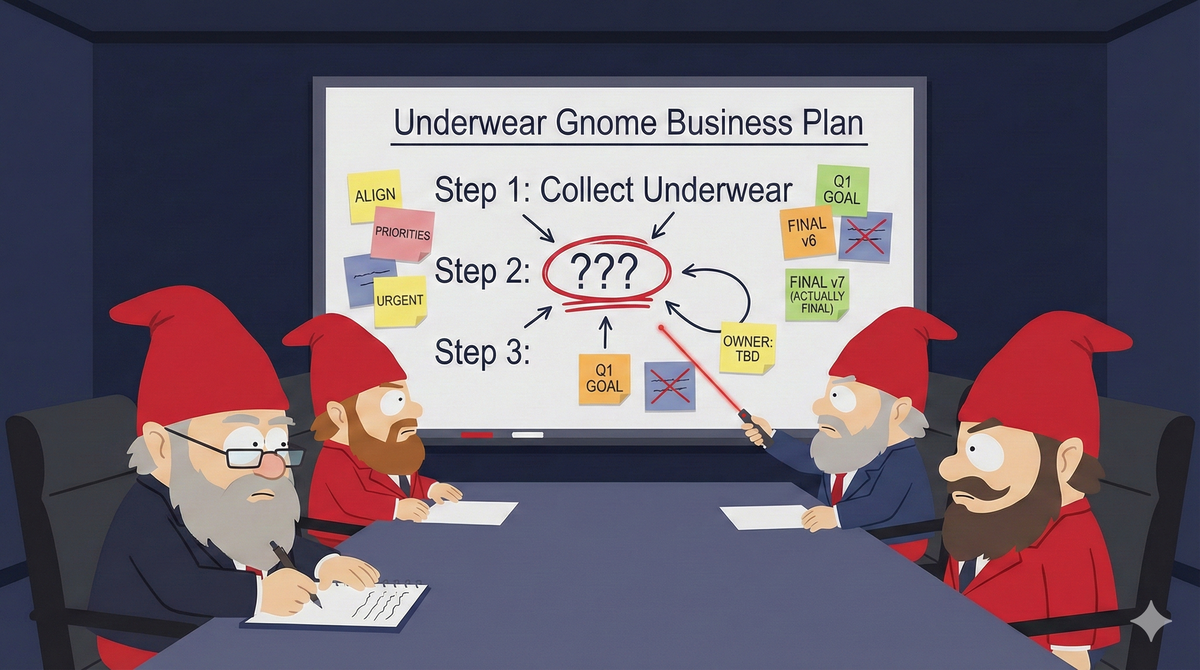
Most companies do not have a strategy. They have a collection of goals, a feature timeline, and a 40-page slide deck that no one reads twice.
When execution fails, leadership usually blames the "process" or the "tools." But the failure often starts earlier. It starts when "strategy" is treated as a noun—a finished object—rather than a verb.
Real strategy is the act of choosing what not to do. If your strategy doesn't make someone in the room uncomfortable or disappointed, it isn't a strategy; it’s a wishlist.
The Strategy Document Trap
A common mistake in growth-stage companies is equating a "Strategy Document" with strategic clarity.
You’ve seen the document: it contains a market analysis, a SWOT diagram, and a list of ten "Strategic Pillars." Because it has ten pillars, it has zero focus. These documents are designed to achieve consensus, not to drive execution.
By trying to include every possible opportunity, these documents fail to provide the only thing an operator needs: a filter for decision-making.
If a team member has to ask you for permission before deviating from a minor task, your strategy has failed. A document doesn't help them decide. A choice does.
Strategy is a Set of Trade-offs
In an operational context, strategy is a logic that links your aspirations to your activities. This logic is built on trade-offs.
Michael Porter famously noted that the essence of strategy is choosing what not to do. For an operator, this means being explicit about what you are sacrificing.
- Speed vs. Quality: You cannot claim to value both equally in a crisis. One must be the "winning" value.
- New Market Entry vs. Retention: Choosing to ignore churn to capture a new market is a strategy. Trying to do both with the same headcount is a disaster.
- Customization vs. Scalability: Saying "no" to a high-paying enterprise customer whose needs don't align with the product roadmap is a strategic decision.
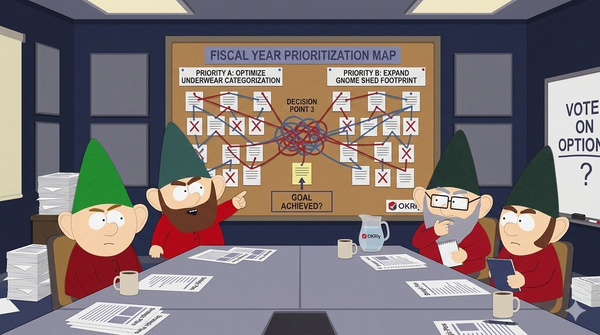
Without these explicit trade-offs, your team will default to "trying to do everything," which leads to the "peanut butter effect"—spreading resources so thin that nothing achieves impact.
How to Test if You Have a Strategy
If you want to know if you have a strategy or just a document, ask your department heads these three questions:
- What are we explicitly NOT doing this year? If they can’t name three high-value projects that were killed to make room for the current priorities, you have a wishlist.
- What is the "losing" side of our primary trade-off? If the answer is "we don't lose anything," your strategy is a hallucination.
- Does this strategy help a junior engineer decide between two tasks at 4:00 PM on a Friday? If it requires a meeting with a VP to clarify, the strategy isn't operational.
Why Strategy Fails in Execution (The OKR Gap)
The bridge between strategy and execution is usually broken at the OKR level.
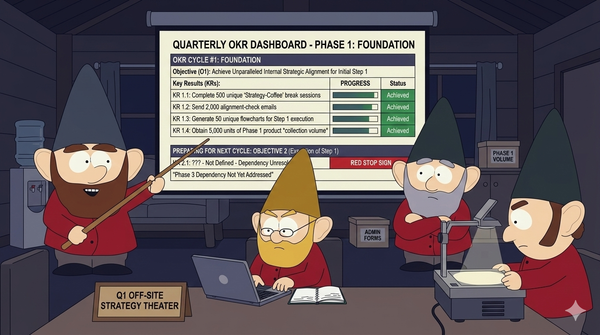
Teams often treat OKRs as a way to track the strategy document. They copy and paste the "Strategic Pillars" into the "Objectives" column. This is backwards.
OKRs should reflect the choices you made. If your strategy is to "Win the Enterprise Market," your OKRs shouldn't just be "Revenue." They should reflect the trade-offs: "Reduce response time for Tier 1 support" at the expense of "Self-serve documentation updates."
When strategy is a choice, OKRs become the pulse of those choices. When strategy is a document, OKRs become a chore.
Common Strategy Mistakes by Company Stage
The nature of the "choice" changes as you scale, but the requirement for a choice remains the same.
Seed to Series A
The strategy is usually "Survival and Signal." The choice is which narrow segment of users to satisfy. The failure mode here is "Vision Drift," where the founder chases every lead, effectively having no strategy.
Series B to Series C
The strategy shifts to "Scale and Systematization." The choice is which parts of the business to automate and which to leave "messy" for now. The failure mode is "Premature Optimization"—trying to fix everything at once and losing the original speed.
Enterprise
The strategy is "Defensibility and Leverage." The choice is which legacy products to starve to fund new growth. The failure mode is "The Document." At this stage, the strategy document becomes so large that it serves only as political cover rather than an operational guide.
Failure Modes: When "Choice" Goes Wrong
Choosing is hard, and it can be done poorly.
- The Pivot Loop: Making new strategic choices every three weeks. This isn't a strategy; it's whiplash. Strategy requires a commitment to a choice for a duration long enough to see results.
- The Top-Down Vacuum: Making choices in a boardroom without understanding the technical or operational constraints.
- The Consensus Death Spiral: Softening the trade-offs so that everyone is "happy." This results in a document that says "we will be the best at everything," which is the fastest way to become mediocre at everything.
Turning Strategy into a Living System
To move from a document to a choice-based culture, you must change how you run your cadence.
- Stop presenting decks. Start presenting trade-offs.
- Reward the "No." When a team lead turns down a lucrative but off-strategy opportunity, publicly recognize it.
- Review the choices, not just the numbers. In your monthly reviews, don't just ask "Are we hitting the target?" Ask "Are the trade-offs we made still the right ones?"
FAQ
What is the difference between strategy and tactics? Strategy is the choice of the battlefield and the logic of why you can win. Tactics are the specific moves you make once the battle has started. Strategy is "Why this way?" Tactics are "How do we execute this move?"
Can a strategy change mid-quarter? It can, but it should be rare. If you change strategy mid-quarter, you are admitting that the original logic was flawed or the environment changed drastically. Constant changes are a sign of a lack of strategic depth.
How do you communicate strategy to a large team? Don't send the deck. Summarize the strategy into three "Even Over" statements. For example: "We value Product Simplicity EVEN OVER Feature Parity with Competitors." This gives the team a tool to make their own choices.
What if two "Strategic Objectives" conflict? They will. That is the point of management. Your job as an operator is to decide which one takes precedence in a given cycle. If they don't conflict, you haven't set ambitious enough goals.
Strategy is not a deliverable. It is a persistent state of clarity. If you are still relying on a document to tell your team what to do, you aren't leading them—you're just giving them a reading assignment.
Stop writing documents. Start making choices.
Applying strategic trade-offs shouldn't be a manual effort for your leadership team. OKRly.ai ensures ensure your weekly execution actually reflects the choices you've made, not just the document you wrote.
Want to Learn More?
A strategy document that doesn't constrain choices isn't a strategy. OKRly.ai turns strategic choices into focused OKRs — so your team knows what to do, what not to do, and how to measure progress.