The Danger of Vanity Metrics in OKR Cycles
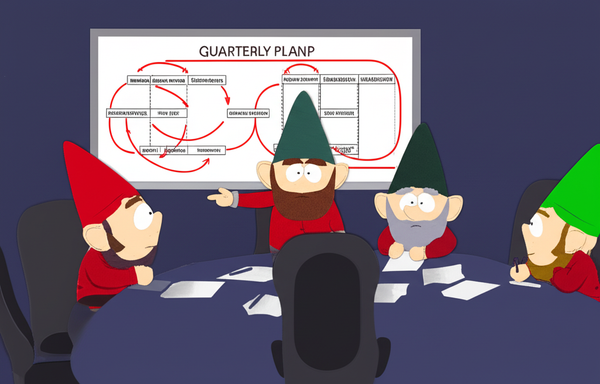
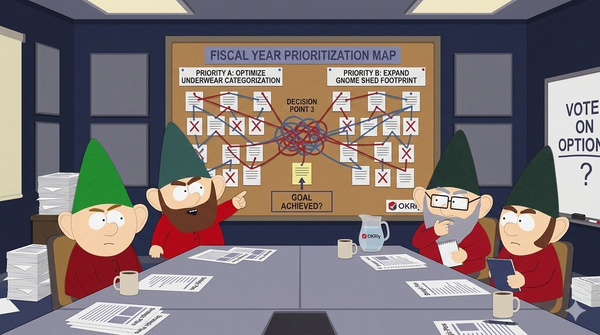
Your OKR dashboard is green. Every metric trends up and to the right. But revenue is flat, churn is rising, and nobody can explain the gap. You have a vanity metrics problem.

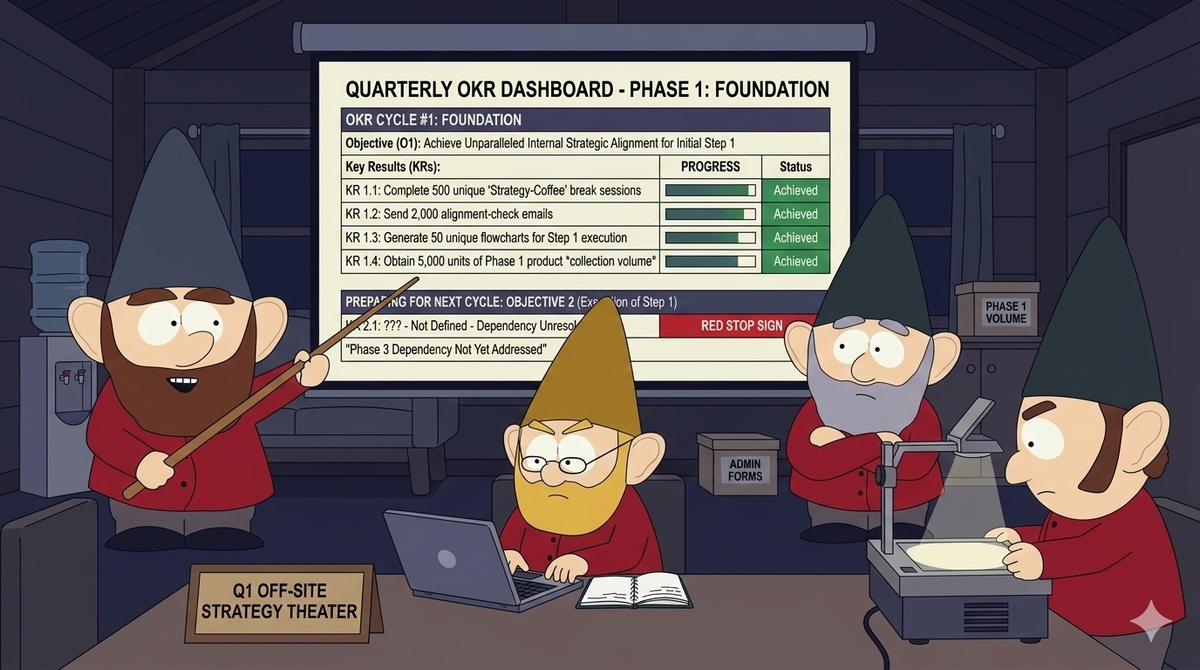
Your OKR dashboard looks great. Page views are up. Signups are growing. Feature adoption is climbing. Everything trends in the right direction. But when the board asks why revenue is flat and customer retention is dropping, nobody can connect the green dashboard to the red bottom line. That's the vanity metrics trap.
Vanity Metrics Feel Good and Mean Nothing
A vanity metric is any number that goes up over time but doesn't correlate with business outcomes you actually care about. Total registered users is a vanity metric — it only goes up, even if most users churned years ago. Page views are a vanity metric — a viral blog post can spike views without generating a single qualified lead.
Vanity metrics are dangerous because they create the illusion of progress. The team hits their key results, the dashboard is green, everyone feels good at the quarterly review. But the business hasn't actually moved. Revenue is the same. Retention is the same. Market position is the same. The OKR system worked perfectly — at measuring the wrong things.
The most insidious vanity metrics are the ones that leadership requested. When the CEO says "I want to see our user count growing," the team builds a key result around total users. It's easy to hit — users accumulate naturally. But if 80% of those users are inactive, the metric is a participation trophy.
How Vanity Metrics Sneak Into OKR Cycles
Teams choose vanity metrics for three reasons, and none of them are malicious.
First, vanity metrics are easy to measure. "Increase page views by 30%" is simple to track, easy to influence, and satisfying to report. "Increase the percentage of trial users who reach their first value moment within 48 hours" is harder to define, harder to measure, and harder to move. Teams gravitate toward the measurable over the meaningful.
Second, vanity metrics are safe. If you pick a vanity metric, you'll probably hit it. Total downloads only goes up. Newsletter subscribers mostly go up. Feature usage goes up if you count raw events. Picking a vanity metric means you won't have to explain a miss at the end of the quarter. It's CYA disguised as goal-setting.
Third, vanity metrics aggregate well. They look good in executive dashboards, board decks, and investor updates. "We grew users 40%!" sounds better than "We grew active users 8% but learned that our activation flow needs a complete redesign." The first version gets applause. The second gets uncomfortable questions. Organizations that optimize for applause will always choose vanity metrics.
How to Replace Vanity Metrics With Real Ones
Apply the "so what?" test to every key result metric. State the metric, then ask "so what?" If the answer doesn't connect to revenue, retention, or a specific business outcome within one or two steps, it's probably a vanity metric.
"Page views are up 30%." So what? "More people are reading our content." So what? "Uh... brand awareness?" That's a vanity metric. Compare: "Trial-to-paid conversion is up from 8% to 12%." So what? "We're acquiring more paying customers from the same traffic." That connects to revenue in one step. That's a real metric.
Replace cumulative metrics with rate metrics. Instead of "total users" track "weekly active users" or "7-day retention rate." Instead of "total revenue" track "net revenue retention" or "expansion revenue per account." Rate metrics can go up or down, which makes them honest. Any metric that can only go up isn't telling you anything useful about the health of your business.
Ask the "decision test": if this metric dropped 20% next week, would we change our behavior? If the answer is "not really," the metric isn't actionable and shouldn't be a key result. Real metrics drive decisions. Vanity metrics drive congratulations.
The Metric Health Check
List every key result metric your team is tracking this quarter. For each one, answer three questions:
- Can it go down? If the metric can only increase over time, it's cumulative and probably vain. Replace it with a rate or ratio.
- Does it connect to money? Can you trace this metric to revenue or cost within two logical steps? If not, it might be measuring activity rather than impact.
- Would a drop change your behavior? If this metric declined significantly, would the team do something different? If the answer is no, the metric isn't actionable.
Any metric that fails two or more of these checks should be replaced or demoted from key result status. Track it if you want, but don't pretend it's a measure of success. Your OKRs should have metrics that occasionally make you uncomfortable. If every metric is green every quarter, you're either a perfect organization or you're measuring comfort, not progress.
FAQ
Are all top-of-funnel metrics vanity metrics?
Not necessarily. Website traffic is a vanity metric if you only count total visits. But "qualified traffic from target persona segments" is a meaningful metric if it correlates with pipeline. The key is specificity and connection to outcomes. A top-of-funnel metric becomes real when it's segmented, has a demonstrated correlation with downstream conversions, and is actionable — meaning you'd change tactics if it moved.
How do I convince leadership to stop tracking vanity metrics?
Show the disconnect. Pull up the vanity metric trend alongside the business outcome it's supposed to drive. If user signups grew 40% but revenue grew 5%, that chart tells the story better than any argument. Then propose the replacement metric and explain what decisions it enables. Leaders respond to "this metric tells us what to do next" better than "this metric is bad."
Can a metric be both a vanity metric and a useful metric?
Yes — it depends on context. Total users is a vanity metric for measuring business health, but it might be useful for capacity planning or infrastructure decisions. The problem isn't the metric itself — it's using it as a key result that represents strategic progress. Keep vanity metrics as operational indicators if they're useful, but never put them in your OKRs as a measure of success.
Want to Learn More?
Stop celebrating metrics that don't move the business. OKRly.ai helps you define key results tied to real outcomes, tracks them honestly (including when they go down), and surfaces the metrics that actually drive decisions — not just dashboards.