When Everything Feels Important, Nothing Is Strategic
When you have ten priorities, you have none. Learn how to identify priority inflation, force executive trade-offs, and use OKRs as a filtering tool to drive actual organizational growth.

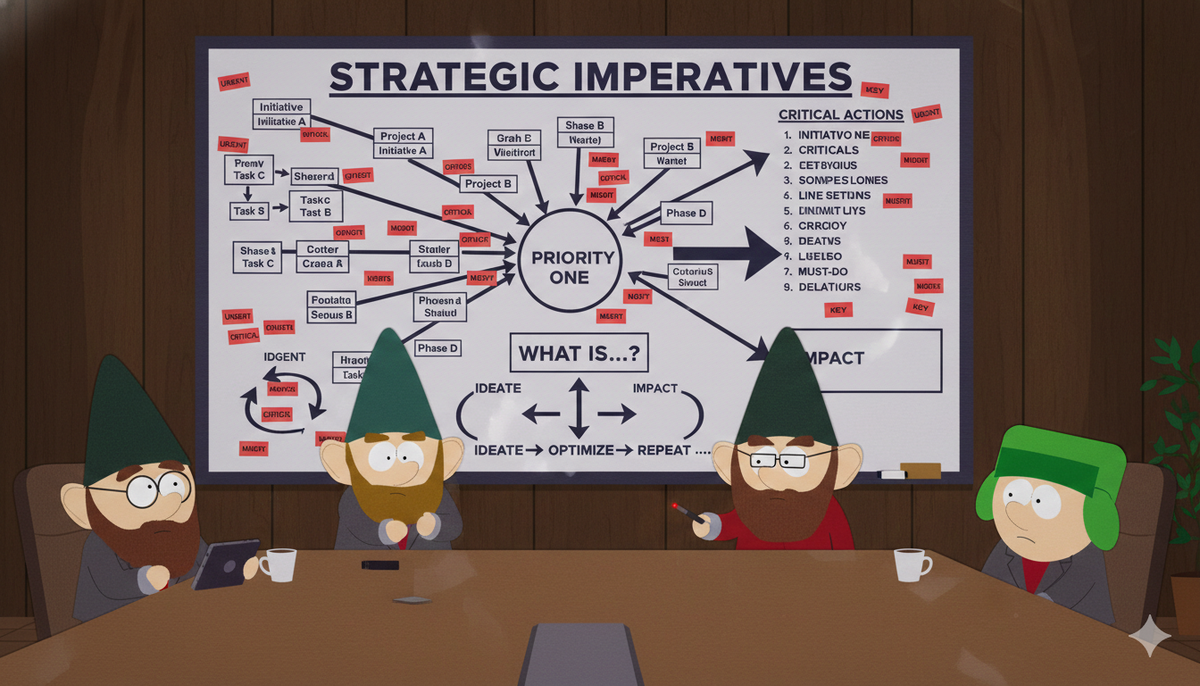
In many growth-stage companies, the word "priority" has lost its meaning. Leadership teams often present a list of ten "top priorities" to their staff. This is a mathematical impossibility.
When you have ten priorities, you have a to-do list, not a strategy. Strategy requires the intentional choice to leave good ideas on the cutting room floor. If your execution feels sluggish despite everyone working long hours, you are likely suffering from priority inflation.
This post covers how to identify when importance has replaced strategy, and how to use the OKR framework to force the trade-offs required for actual growth.
The Cost of Saying Yes to Everything
Operators often fall into the trap of "incrementalism." They see five opportunities, all of which have a positive expected value. Because each project makes sense in isolation, they approve all five.
The result is a diluted organization. When resources are spread thin, the most complex and impactful work—the kind that moves the needle—is the first to suffer. Simple, low-leverage tasks get finished because they are easy. Hard, strategic shifts stall because they require a level of "deep work" and cross-functional coordination that a fragmented schedule cannot support.
The Fractional Tax
Every new priority added to a team’s plate introduces a context-switching tax. Research and practical experience suggest that once an individual manages more than three distinct workstreams, their effectiveness in any single one drops by 20% or more. At five workstreams, you aren't an operator; you are a professional meeting attendee.
Signs You Are Failing to Prioritize
You can diagnose priority inflation by looking at three specific areas of your business:
- The "And" Goal: Look at your quarterly objectives. If they are joined by the word "and" (e.g., "Scale the sales team AND rebuild the core database"), you haven't made a choice. You've lumped two distinct risks into one bucket.
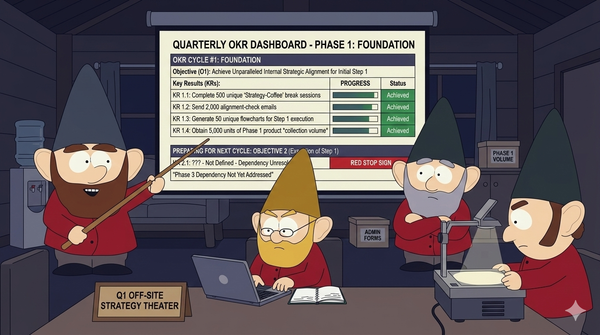
- The Middle-of-the-Road KPI: Are your Key Results all trending toward 50-60% completion? This usually indicates that teams are doing "just enough" to keep every project alive, but not enough to win on any of them.
- Cross-Functional Gridlock: When Marketing needs Design, but Design is busy with Product, who is busy with Engineering, it’s a sign that your priorities are not aligned. Every department has its own "Top 1," and they don't match.
Using OKRs as a Filtering Mechanism
OKRs are often marketed as a tracking tool. This is a mistake. OKRs are a filtering tool. Their primary value is providing a logical reason to say "no."
The Rule of Three
At the company level, you should have no more than three Objectives. Each Objective should have no more than three Key Results.
This constraint is intentional. It forces you to ask: "If we could only fix three things this quarter to ensure the company's survival or growth, what would they be?" If you can't answer that, you don't have a strategy yet; you have a wish list.
Vertical vs. Horizontal Prioritization
Horizontal prioritization is when you rank tasks 1 through 10. The problem is that #4 still gets worked on while #1 is struggling.
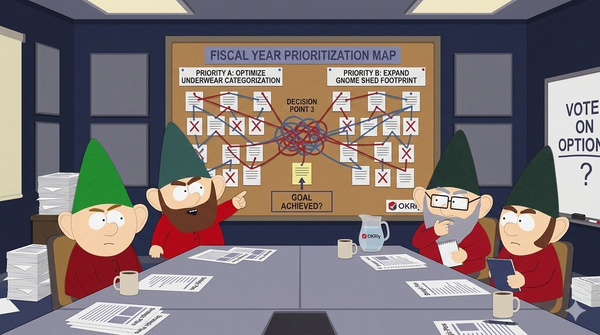
Vertical prioritization means you draw a hard line. Everything above the line is funded and staffed. Everything below the line does not exist for the next 90 days. It isn't "delayed"—it is ignored. This protects the team from the guilt of "not getting to it" and the distraction of "thinking about it."
Common Failure Modes in Execution
Even with OKRs, many COOs struggle with the implementation of focus. Here are the most common ways prioritization fails in practice:
1. The "Shadow" Priority
This happens when a founder or executive brings a "quick idea" to a team outside of the OKR cycle. Because it’s "quick," it isn't documented. But three "quick" ideas a week equate to 15% of a team's capacity.
- The Fix: Every task must be mapped to a Key Result. If it doesn't map, it doesn't happen. No exceptions.
2. Confusing Activity with Impact
Teams often prioritize what they can do over what they should do. Shipping a new feature is an activity. Increasing retention by 5% is an impact.
- The Fix: Write Key Results as outcomes, not outputs. If the team spends the whole quarter "working hard" but the metric doesn't move, the priority was not achieved.
3. The "Keep the Lights On" (BAU) Trap
Leaders often forget that 60-80% of a team's capacity is consumed by Business As Usual (BAU). If you plan your OKRs against 100% of your team's capacity, you are guaranteed to fail.
- The Fix: Plan OKRs for only 30% of your team's time. The rest is for keeping the company running. This forces the OKRs to be even more selective.
When Focus Fails: Edge Cases
Ruthless prioritization is not a silver bullet. There are times when it can backfire.
- During a Pivot: If the company is in a "discovery" phase, over-indexing on one metric can be dangerous. You may need to run several small bets simultaneously. However, even here, the "priority" is the learning, not the product.
- Technical Debt: If you only prioritize growth metrics, your infrastructure will eventually collapse. You must treat "System Stability" or "Debt Reduction" as a strategic priority, not something handled in the gaps.
Summary for the Operator
If you feel like your team is "busy but not productive," the problem is likely your inability to choose. Focus is uncomfortable because it requires you to be wrong about what you didn't do. But as a COO, your job isn't to be busy; it's to ensure the organization's limited energy is applied to the single most important point of leverage.
FAQs
How do I tell my CEO that we have too many priorities? Don't use feelings; use math. Show a resource allocation map. Demonstrate that the current list of 10 priorities requires 150% of the team's capacity. Ask the CEO: "Which of these 4 projects should we do poorly so that these 6 can be done well?"
Is it okay to change priorities mid-quarter? Yes, but the cost is high. If you change a priority, you must officially "kill" the one it replaced. Never just add to the pile. Changing priorities more than once a quarter is usually a sign of poor upstream strategy.
What if a "good" idea comes up that isn't in our OKRs? Document it in a "Backlog" or "Parking Lot." If it is truly a game-changer, wait for the next quarterly planning session. If it can't wait 6 weeks, it's either an emergency or your planning cycle is too long.
How many Key Results are too many? If a team has more than 5 Key Results total across all objectives, they will lose focus. 2 to 3 is the "Goldilocks" zone for high-performing teams.
Ruthless prioritization is an ongoing discipline, not a one-time event. It requires a cadence of check-ins to ensure that "busy work" hasn't crept back into the schedule. OKRly.ai acts as your AI Chief of Staff, monitoring these signals and flagging when your team is losing focus before the quarter is lost.
Stop managing a list of tasks and start managing a strategy. Let AI handle the tracking while you handle the trade-offs at OKRly.ai.
FAQ
How many strategic priorities should a company have at once?
Three to five at the company level. If you have more, you don't have priorities — you have a list. Every priority beyond five dilutes focus and increases coordination costs. The discipline of strategy is choosing which important things to do now and which important things to defer.
How do you convince leadership that fewer priorities means better results?
Show them last quarter's results. Count how many initiatives were planned versus completed. If the completion rate is below 70%, the team is overcommitted. Then show what full commitment to fewer priorities would look like — more resources per initiative, faster completion, higher quality. The math usually makes the argument better than any philosophy.
What do you do when a genuinely urgent issue arises mid-quarter?
Treat it as a swap, not an addition. If something urgent enough to act on arrives, name what it displaces. "We're taking on this customer escalation, which means Initiative X slips two weeks." Making the trade-off explicit prevents the slow accumulation of unplanned work that turns every quarter into a scramble.
Want to Learn More?
When everything is a priority, nothing gets done well. OKRly.ai helps you lock in a focused set of OKRs, track progress against what matters, and say no to everything else with confidence.