Why Most Leadership Teams Confuse Vision With Direction
Vision is a destination, but direction is the path. Learn why most leadership teams fail to bridge the gap between their "North Star" and weekly execution, and how to set a direction that actually drives results.

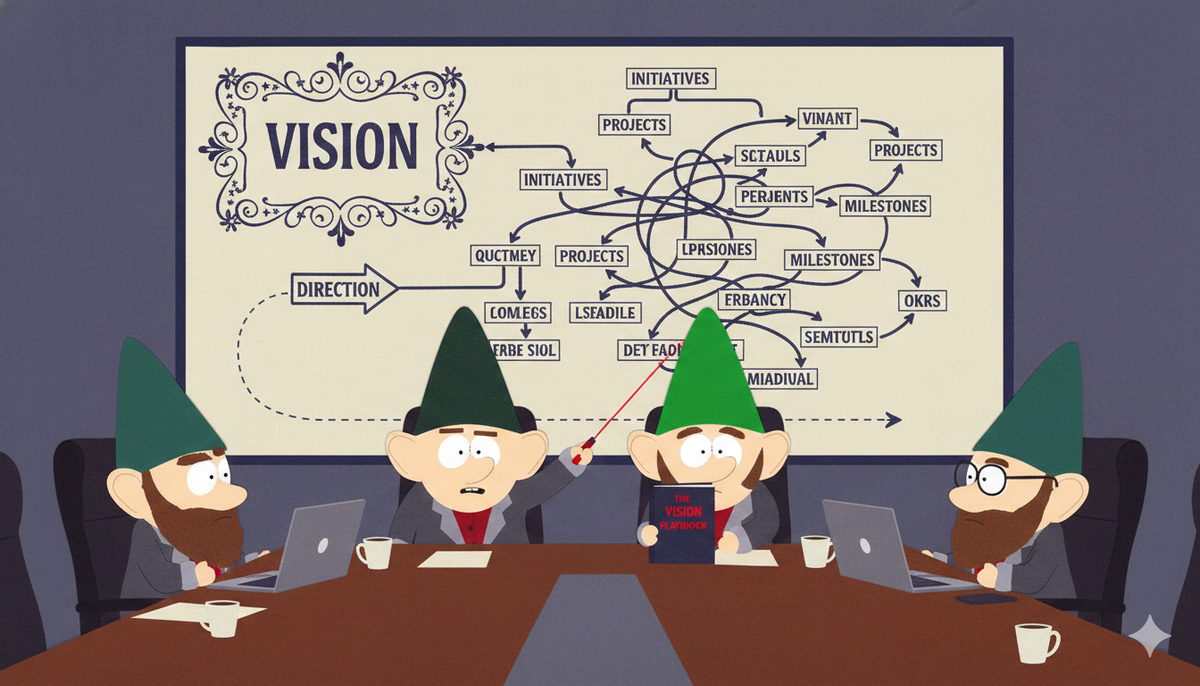
Vision is a destination. Direction is a compass heading.
Most leadership teams spend weeks offsite crafting a "North Star" vision. They return with a polished sentence about "transforming the industry" or "becoming the leading platform for X." They present this to the company and expect execution to follow naturally.
It never does.
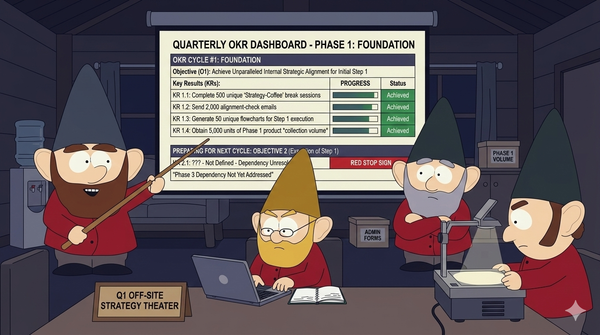
The gap between a three-year vision and a ninety-day OKR cycle is where most companies lose their momentum. Vision is inspirational, but it is not a substitute for Direction. Without Direction, your teams will move in opposite directions, all while claiming they are heading toward the same North Star.
The Definition of the Gap
Vision describes a future state. It is static. It tells the team what the world looks like when you win.
Direction describes the path. It is dynamic. It identifies the specific obstacles you will overcome this year and the trade-offs you are making to get there.
If your vision is "to be the most customer-centric logistics company," your Direction must answer: Are we prioritizing speed over cost this quarter? Are we expanding our fleet or optimizing our software?
Vague vision statements allow every department head to project their own priorities onto the company's goals. The Head of Product sees "customer-centric" as a new feature. The Head of Ops sees fewer delivery errors. Without a clear Direction, they will compete for the same resources, and neither will succeed.
Why Vision Alone Leads to Operational Drift
When a leadership team provides vision without Direction, they create operational drift. Drift happens when talented people work hard on the wrong things because the "right things" weren't defined narrowly enough.
Consider a mid-stage SaaS company. The vision is "to dominate the enterprise market."
- The Sales Team interprets this as: "Close every deal, regardless of feature requests."
- The Product Team interprets this as: "Build deep security integrations."
- The Customer Success Team interprets this as: "High-touch, manual onboarding for everyone."
By the end of Q2, the product is a mess of custom requests, the engineers are burned out, and the burn rate has doubled. Each team was following the "vision," but they lacked a shared direction.
The Three Components of Actual Direction
To turn vision into execution, leadership must provide three things:
1. The Strategic Bet
Direction requires an opinion. You must state: "We believe that by doing A, we will achieve B, because of C." If your strategy doesn't exclude certain activities, it isn't a strategy. It's a wish list.
2. High-Level Trade-offs
Operators need to know what to ignore. Clear Direction explicitly states what the company is not doing. "We are focusing on retention over new logo acquisition for the next six months." This allows a Lead Engineer to say "no" to a sales-led feature request without fear of repercussion.
3. The Sequence
Vision is all-at-once. Direction is one-at-a-time. A leadership team that tries to move every lever simultaneously moves none of them. Direction defines the order of operations. What must be true by June so that we can take the next step in July?
Transitioning from Vision to OKRs
The most common failure in OKR implementation is linking Key Results directly to a Vision statement. This is a leap too far.
The hierarchy of execution should look like this:
- Vision: The 3-5 year destination.
- Strategy: The logic of how you win.
- Direction: The 12-month thematic focus.
- Objectives: The 90-day outcomes.
- Key Results: The metrics that prove the outcomes.
If you skip "Direction," your OKRs will be a fragmented collection of departmental tasks. They will lack the cohesive force needed to move the vision forward.
Case Study: The Pivot That Wasn't
I once worked with a Series C company that wanted to move from SMB to Enterprise. Their vision was clear. Their OKRs looked "correct" on paper: "Hire 5 Enterprise AEs," "Launch SSO," "Increase ACV by 20%."
The project failed because the leadership team didn't provide Direction on the method. They hadn't decided if they were going to be a "product-led enterprise" company or a "sales-led enterprise" company.
Because the Direction was missing, the Sales team built a heavy outbound motion while the Product team continued building self-serve tools. The two motions fought each other. The "vision" was shared, but the "direction" was bifurcated.
How to Audit Your Own Direction
Ask your department heads these three questions individually:
- What is the single most important obstacle we are overcoming this quarter?
- What is one project we are intentionally delaying to ensure we win?
- How does your team's current top priority directly invalidate a competitor's strength?
If you get different answers, you have a vision, but you don't have Direction.
Common Mistakes in Setting Direction
- Confusing "More" with "Direction": "Our direction is to grow 2x" is not Direction. That is a target. Direction is how you grow 2x (e.g., "by dominating the mid-market manufacturing niche").
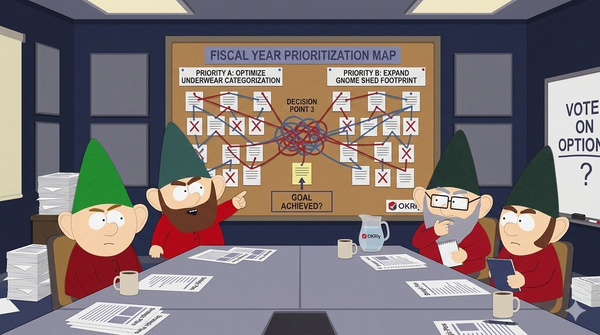
- Democratic Dilution: Trying to make every executive happy by including everyone's pet project in the "direction." This leads to a lack of focus.
- Setting Direction Once a Year: Markets change. Direction must be revisited quarterly. While the vision remains stable, the path to get there must be adjusted based on real-world data.
Why Teams Get This Wrong in Practice
Most leaders avoid setting a clear Direction because Direction requires making hard choices. It requires saying "no" to good ideas.
It is emotionally easier to stay at the "Vision" level because everyone can agree on a bright future. As soon as you move to "Direction," you create winners and losers within your own organization. You might fund the Marketing team's new initiative while cutting the Research team's budget.
Great operators accept this friction. They know that the cost of internal harmony is often external failure.
FAQS
What is the difference between company vision and strategic DirectionDirection? Vision is the long-term goal or "North Star" of the company. Strategic Direction is the specific path, including trade-offs and priorities, that the company chooses to reach that vision over a set period, typically 6-12 months.
How do I know if my company has a direction problem? If your teams are consistently hitting their individual OKRs but the company isn't moving toward its long-term goals, you have a direction problem. This usually manifests as "siloed success," where departments work at cross-purposes.
Can a company have a vision without a strategy? Yes, and most do. A vision without a strategy is just a dream. Strategy provides the logic for achieving the vision, while Direction provides the immediate focus for execution.
How often should leadership update the company's DirectionDirection? While the vision should stay consistent for years, the strategic Direction should be reviewed quarterly and potentially adjusted based on market shifts, execution data, and competitive moves.
Vision doesn't execute itself; Direction does. If you're tired of seeing your strategic goals get lost in the daily grind, let OKRly.ai provide the AI-driven oversight your leadership team needs to stay aligned.
Stop guessing whether your teams are moving in the right Direction and start seeing progress in real time. Fix your execution cadence today.
FAQ
What's the difference between vision and direction?
Vision describes where you want to be in the long term. Direction describes what you're doing this quarter to get there. Vision is "We'll be the most trusted platform for mid-market HR teams." Direction is "This quarter, we're reducing onboarding time from 3 weeks to 3 days by focusing exclusively on the self-serve flow." One inspires. The other instructs. Teams need both, but they need direction more urgently.
Can a company have a great vision but poor direction?
Absolutely. It's one of the most common leadership failures. The vision is compelling, the all-hands was inspiring, and teams leave energized but directionless. They know where the company wants to be in five years. They don't know what to prioritize this month. Vision without direction creates enthusiasm that dissipates into fragmented execution.
How do you translate vision into direction?
Break the vision into the 2-3 strategic bets you're making this year. Then break those bets into quarterly objectives with measurable key results. Each level of translation should be more specific and more actionable than the last. If a team lead can't look at their OKRs and know what to work on this week, the translation isn't done yet.
Want to Learn More?
Vision sets the destination. Direction tells your team what to do this week. OKRly.ai translates company-level vision into team-level OKRs with clear key results, so inspiration becomes execution.