The Work Before the Work: Why Your OKR Drafting is Premature
Stop wasting time on OKR wording. After 35+ quarters running OKRs, I’ve learned success is won before drafting. Learn the 5 leadership steps—naming direction, surfacing constraints, and choosing a "Quarterly Mode"—to ensure your OKRs reflect reality, not just decorate it.

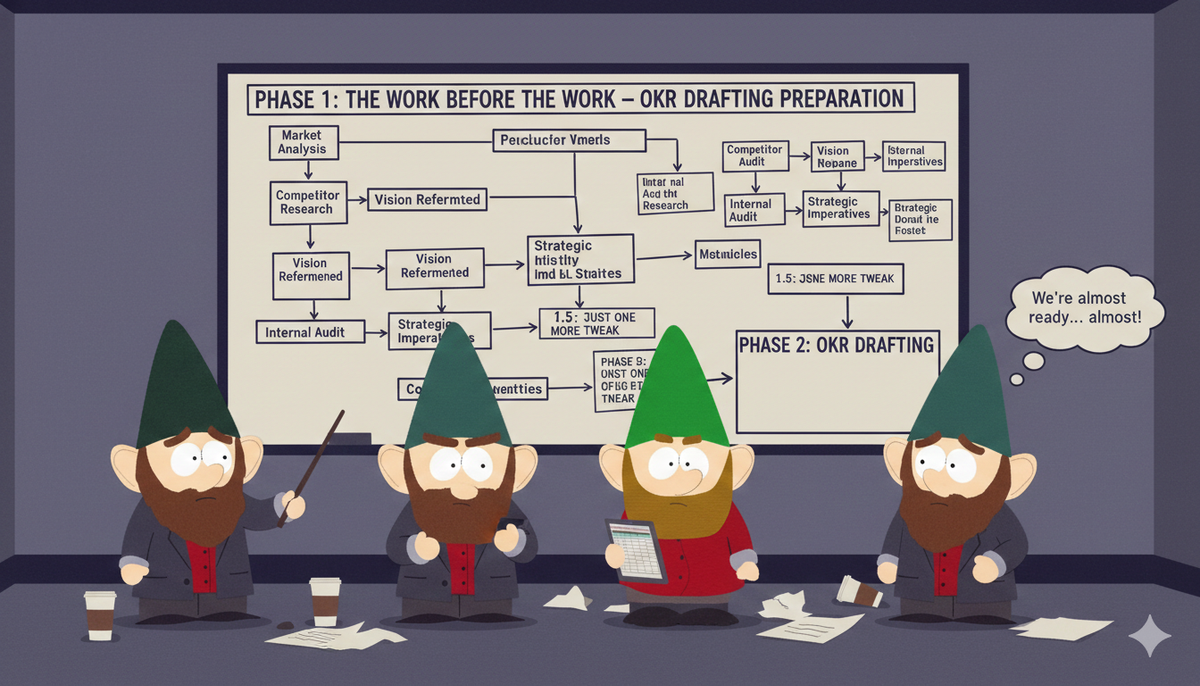
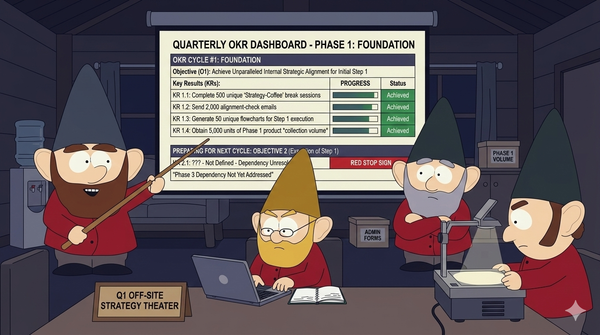
Most leadership teams treat OKR season like a writing exercise. They retreat into a conference room, open a blank document, and begin the pedantic dance of debating "leading vs. lagging" indicators.
I’ve run OKRs for over 35 quarters across public and private companies. If there is one thing those nine years of operational scars have taught me, it’s this: When OKRs fail, it’s rarely because the writing was bad. It’s because the leadership work before the drafting was skipped.
OKRs are an execution system, not a strategy substitute. If you haven’t done the heavy lifting of setting direction and surfacing constraints, your OKRs aren't a roadmap—they’re just expensive wallpaper.
1. Direction is a Point on the Map, Not a Vision Statement
Strategy is the art of sacrifice. Before a single Objective is penned, leadership must move past "polite" language and name a direction that forces a tradeoff.
In my experience, "Real Direction" sounds like an ultimatum:
- Real: "Fix churn before we spend another dollar on CAC."
- Fake: "Balance growth with customer satisfaction."
The COO Test: Complete this sentence: "To win this quarter, we are explicitly choosing to fail at, or ignore, _______." If you can’t answer that, you aren't ready to draft.
2. Surface the "Unpolite" Constraints
OKRs don't fix organizational friction; they expose it. If your leadership team is lying to themselves about why progress is stalled, the OKRs will quietly fight reality. Reality always wins.
Before drafting, you must audit your real constraints:
- Organizational Exhaustion: Is the team too burnt out to pivot?
- Mandate Collision: Does the Board want "Growth" while the CEO wants "EBITDA"?
- Technical Debt: Are you trying to build a skyscraper on a swamp?
If these aren't acknowledged upfront, your Key Results will be viewed as "punitive" rather than "possible."
3. Define the "Quarterly Mode"
Not all quarters are created equal. Treating an "Investment Quarter" like an "Optimization Quarter" is a leadership failure that leads to mass resentment. Leadership must align on the "Mode" before the teams start brainstorming:
| Mode | Priority | Acceptable Cost |
| Stabilization | Stop the bleeding / Reduce volatility | Slowed growth |
| Investment | Build future capability | Short-term inefficiency |
| Acceleration | Aggressive market capture | Operational strain |
4. Aggressive Problem Space Reduction
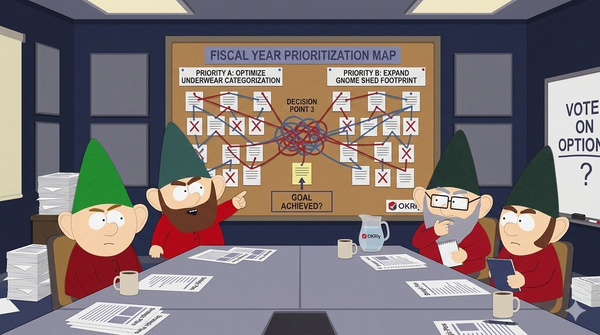
The most common mistake I see is "The Christmas Tree Effect"—everyone tries to hang their department's favorite project on the OKR tree.
As a COO, my rule is simple: Reduce the problem space before you reduce the wording. If you could only move two needles this quarter, which two would they be? If leadership can’t agree on the "Vital Few," the teams will naturally gravitate toward the "Trivial Many."
5. Establish the "Truth" Protocol
Before the first KR is tracked, you must decide how progress will be reviewed. This is a cultural decision, not a software one.
- Is a "Red" status an invitation for help or a reason for a performance review?
- Are we optimizing for safety (sandbagging) or for truth (ambition)?
If you don't define the review cadence and the "psychological safety" of the data upfront, your teams will game the confidence scores. You’ll get 100% completion on paper and 0% impact on the business.
The Leadership Truth No One Likes
OKRs don't fail because teams don't understand the framework. They fail because leaders skip the uncomfortable, high-friction work of choosing.
The work of saying "No." The work of aligning reality with incentives. If you are willing to do that work, OKRs are the most powerful execution tool in your belt. If you aren't, no amount of clever drafting will save you.
Strategic Operations Checklist
- [ ] Have we identified the "Sacrifice" for this quarter?
- [ ] Is the "Quarterly Mode" clearly communicated?
- [ ] Have we capped our top-level Objectives at three?
FAQ
What should happen before OKR drafting begins?
Three things: a strategic context briefing from leadership (what matters this quarter and why), a review of the previous quarter's results (what we learned), and a capacity assessment (what we can realistically take on). Skip any of these and you'll draft OKRs in a vacuum — they'll be internally consistent but strategically disconnected.
How do you know if your OKR drafting is premature?
If the first 30 minutes of your OKR planning session is spent debating what the company's priorities are, you started drafting too early. The priorities should be settled before anyone opens a document. OKR drafting is an implementation exercise, not a strategy exercise. If you're still deciding strategy while writing OKRs, you'll end up with OKRs that encode confusion instead of clarity.
Can you do the pre-work asynchronously?
Most of it, yes. Strategic context can be shared as a written brief. Last quarter's results can be reviewed individually. Capacity calculations are math, not discussion. Save the synchronous time for the parts that require debate: resolving conflicts between team priorities, making trade-offs, and finalizing commitments. That's the high-value work that deserves face-to-face time.
Want to Learn More?
Don't draft OKRs in a strategic vacuum. OKRly.ai gives you continuous visibility into OKR progress and strategic alignment, so when it's time to plan the next quarter, the groundwork is already done.