It’s Not Love If You Won’t Commit - A Valentine’s Day Post About Execution
Stop treating OKRs like a first date. Learn why "interest" kills execution and how experienced COOs build a culture of commitment to ensure goals actually get reached, rather than rotting in a spreadsheet by mid-quarter.


Execution is Commitment: Your OKRs Fail Without a Vow
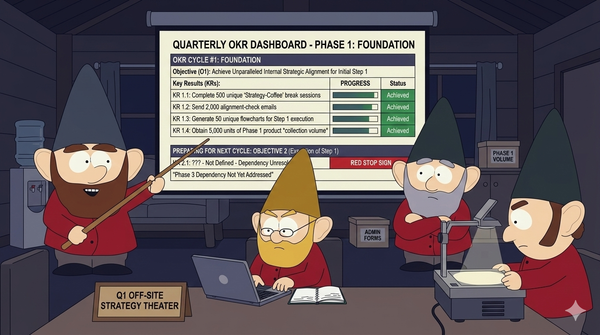
In business, we often treat OKRs like a first date. There is excitement, a clean slate, and a lot of talk about a bright future. But by week four, the "romance" of the new strategy has faded. The reality of daily fires and technical debt sets in. Most teams don't actually have a strategy problem; they have a commitment problem.
If you aren't willing to say "no" to good ideas to protect your "great" objectives, you aren't committed. You are just interested. In an operational context, interest is expensive, and commitment is profitable.
The Difference Between Interest and Commitment
Interest is setting a goal because it looks good in a board deck. Commitment is changing your calendar to reflect that goal.
Operators see this distinction most clearly during the weekly sync. An interested team talks about why they were busy. A committed team talks about why the needle didn't move and what they are reallocating to fix it.
Commitment in execution requires three things:
- Resource Allocation: Moving the best people to the most important problems.
- Emotional Resilience: Accepting that some "business as usual" tasks will fail so the OKRs can succeed.
- Consistency: Showing up to the cadence even when the data is embarrassing.
Why Teams Ghost Their Own Goals
Most OKR cycles follow a predictable decay. January is for planning. February is for "getting started." By March, the OKRs are forgotten until the end-of-quarter "scorecard" exercise, which is usually just an autopsy of a dead initiative.
Teams "ghost" their goals for a few specific reasons:
The "Everything is a Priority" Trap
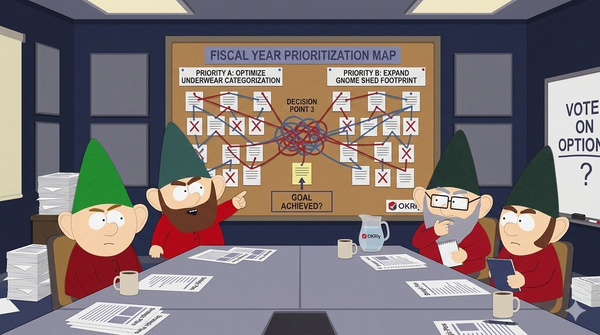
When you have 12 Objectives, you have zero. High-growth companies often struggle with the fear of missing out on market opportunities. They try to date every trend at once. True commitment requires a "monogamous" focus on 2-3 core objectives. If you won't kill a project to save an OKR, you don't actually care about the OKR.
Lack of a Forcing Function
Execution doesn't happen in a vacuum. It happens in the gaps between meetings. Without a rigorous weekly check-in—a "vow" to look at the numbers every seven days—the gravity of the inbox will always win.
No Feedback Loop
If a team misses a Key Result (KR) and nothing changes in their daily workflow, the OKR was never real. It was a suggestion.
The Cost of Non-Commitment
The cost isn't just a missed target. It is the erosion of trust within the organization.
When a COO or Founder sets a goal and then fails to hold the line, high performers notice. They realize that the "North Star" is actually a weather vane. Over time, this leads to:
- Operational Cynicism: "Why work hard on these? They'll change in a month."
- Resource Dilution: People working on "stealth" projects that they think are important because the official ones feel fake.
- Velocity Loss: The friction of indecision slows down every department.
How to Rekindle the Execution Flame
If your current OKR cycle feels cold, you don't need a new framework. You need better habits.
1. Prune the List Mid-Quarter
It is better to admit a goal is dead and focus on the remaining ones than to pretend you are still pursuing everything. If a project is at 10% completion with 30% of the time left, commit to the pivot or the kill.
2. Radical Transparency
Make the status of every OKR visible to everyone. Not just the leadership team. When progress is public, commitment increases. No one wants to be the person who forgot their "anniversary" with the company goals.
3. Automate the Cadence
The hardest part of commitment is the manual labor of tracking. When you have to spend three hours a week just gathering data for a slide deck, you will eventually stop doing it. Use systems that pull data automatically so the meeting is about decisions, not reporting.
When Commitment Fails: The Edge Cases
There are times when breaking a commitment is the right operational move.
- Market Shocks: A competitor's move or a macro-economic shift can render a KR irrelevant.
- False Assumptions: If you committed to a KR based on a technical assumption that proved impossible, pivot immediately.
The key is that these should be conscious decisions, not accidental drifts. A pivot is a new commitment. Drifting is just a lack of discipline.
FAQS
What should I do if my team is ignoring our OKRs?
Stop the week. Hold a "Reset" meeting. Ask: "Is this goal still the most important thing for the company?" If yes, ask: "What is standing in the way of you spending 80% of your time on it?" Fix the blocker or change the goal.
How many OKRs are too many for a startup?
For most startups, 2-3 company-level Objectives with 3 Key Results each is the limit. Any more and you are diluting your talent.
Why do OKRs feel like a chore instead of a strategy?
This happens when OKRs are treated as "extra work" on top of the day job. OKRs are the job. If the daily tasks aren't contributing to the KRs, those tasks should be questioned.
How do you handle OKRs when the founder keeps changing priorities?
This is a "Commitment Contract" issue. The COO or Head of Ops must show the founder the "Tax of Change." Every time a priority shifts mid-cycle, 2-3 weeks of momentum are lost. Document the cost of these shifts to encourage more stable commitments.
Execution isn't about the intensity of the kickoff; it’s about the consistency of the follow-through. If you’re tired of OKRs that rot in a spreadsheet, you need a system that treats your goals like the commitments they are.
Stop letting your strategy fade by February. OKRly.ai provides the AI-driven cadence and visibility required to turn "interest" into actual outcomes.
FAQ
What does real commitment look like in OKR execution?
Real commitment means resources are allocated, trade-offs are accepted, and the team has said no to other things to make room. If a key result has an owner but no dedicated time, no budget, and no explicit deprioritization of competing work, it's not a commitment — it's a hope with someone's name next to it.
How do you know if your team is truly committed to their OKRs?
Ask what they've stopped doing or said no to in order to focus on their OKRs. If the answer is "nothing," the OKRs were added on top of everything else, which means they're aspirational, not operational. Commitment requires sacrifice. No sacrifice, no commitment.
What's the difference between commitment and rigidity?
Commitment means you'll pursue the outcome with focus and persistence. Rigidity means you'll pursue the exact plan even when evidence says it's wrong. Commit to the key result (the outcome). Stay flexible on the approach (how you get there). If the data says your approach isn't working, change the approach — but don't abandon the outcome at the first sign of difficulty.
Want to Learn More?
Commitment isn't a feeling — it's a resource allocation decision. OKRly.ai makes commitments visible by tracking OKR progress in real time, so you can see who's truly committed and who's just going through the motions.