When Strategy Becomes a Morale Problem
When strategy is vague or unrealistic, it doesn’t just hurt the business—it destroys team morale. Learn how to identify strategic drag, bridge the execution gap, and turn your high-level vision into a source of momentum rather than frustration for your operators.

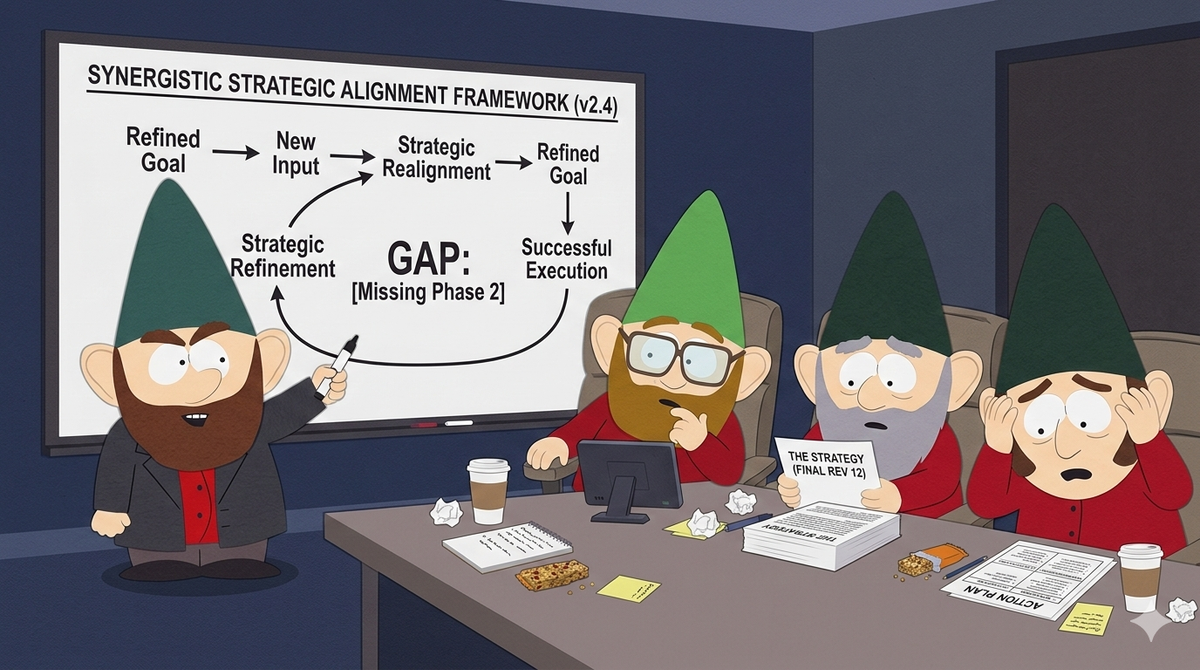
Most leaders view strategy as an intellectual exercise. They spend off-sites debating market positioning, competitive moats, and three-year horizons. They emerge with a slide deck, present it at an All-Hands, and assume the job is done.
But for the people responsible for doing the work, a poorly communicated or unrealistic strategy isn’t just a business risk. It is a source of profound daily frustration. When the link between “what we are doing today” and “where we are going” is broken, morale doesn’t just dip—it evaporates.
If your team is exhausted but the needle isn’t moving, you don’t have a productivity problem. You have a strategy-to-execution problem that has become a cultural tax.
The Weight of Ambiguity
Ambiguity is the silent killer of high-performance cultures. High achievers want to win. To win, they need to know what the scoreboard looks like and which direction they are running.
When strategy is “clever” but not “clear,” several things happen to a team’s psyche:
Decision Paralysis: Mid-level managers stop making autonomous choices because they can’t predict which ones align with the shifting north star.
Prioritization Fatigue: Without a clear strategic filter, every request feels like a P0. The team stays in “emergency mode” indefinitely.
Cynicism: When leadership announces a “New Strategic Pillar” every six months without finishing the last one, the team stops listening. Strategy becomes “just another thing management says.”
The “How” is Where Morale Lives
Operators often hear that strategy is the What and execution is the How. This is a dangerous oversimplification.
Strategy must include the logic of how we will win given our specific constraints. If a strategy requires 100 units of effort but the team only has 60, that isn’t a “stretch goal.” It’s a math error.
When you hand a team an impossible goal without the requisite resources or a plan to stop doing lower-value work, you aren’t being “ambitious.” You are being an absentee leader. The team knows the goal is unattainable. They will go through the motions, but they won’t commit their best thinking to a lost cause.
Signs Your Strategy is Hurting Your Culture
You can identify strategic drag by looking for these symptoms in your weekly cadence:
The “Status Update” Trap: In weekly meetings, people report on activity (what they did) rather than progress (how it moved the needle). This happens because they aren’t sure which needle actually matters.
Shadow Work: Teams start working on “pet projects” that they know are valuable because they’ve lost faith in the official roadmap.
The Middle Management Squeeze: Your directors are burned out. They are catching the pressure from above to “execute” and the frustration from below about “unrealistic expectations.”
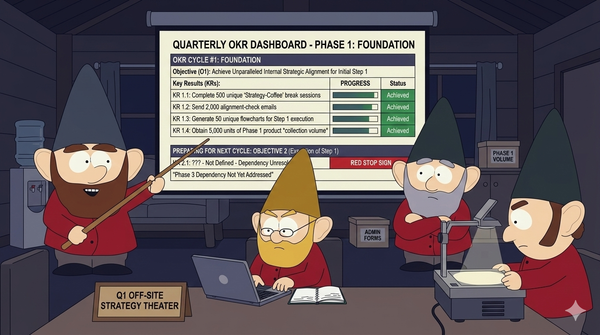
OKR Fatigue: OKRs are treated as a compliance exercise—something to be filled out in a spreadsheet on Friday afternoon and forgotten by Monday morning.
The Strategy-Execution Bridge: A Moral Imperative
Closing the gap requires more than better software. It requires a shift in how you define an “Operating System.”
A strategy only becomes real when it is translated into the language of the individual contributor. This is the role of the Chief of Staff or COO: to act as the “Head of Translation.”
1. Radical Narrowing
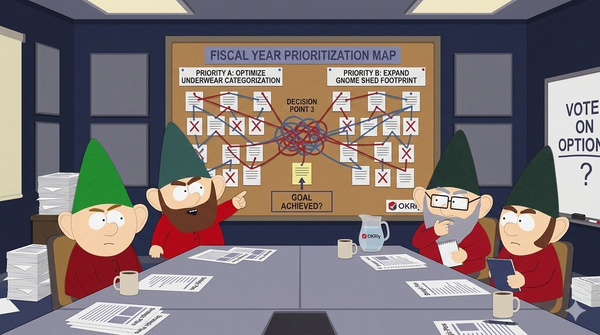
Most strategies fail because they try to do too much. A strategy that lists eight “top priorities” has zero priorities. To protect morale, you must kill good ideas to make room for the great ones. This reduces the cognitive load on your team and allows them to feel the “win” of actually finishing something.
2. The Context Layer
Don’t just cascade goals; cascade context. If a Key Result changes, the team needs to know why the underlying strategic assumption changed. If they don’t understand the “Why,” the change feels like whiplash.
3. Shorten the Feedback Loop
Long-term strategy is a series of short-term bets. If a bet isn’t paying off, kill it quickly. Leaving a failing project on life support out of “strategic commitment” is a massive drain on morale. It forces talented people to waste their lives on work that doesn’t matter.
When OKRs Make it Worse
Many companies implement OKRs to “fix” their execution, only to find it makes morale worse. This usually happens because:
The OKRs are top-down only: The team feels like the goals were “done to them” rather than “developed with them.”
The OKRs are too tactical: They look like a glorified To-Do list rather than a set of outcomes.
The OKRs are disconnected from reality: They don’t account for “Run the Business” (RTB) work, leaving the team feeling like they have two full-time jobs.
The Operator’s Path Forward
To fix a morale problem rooted in strategy, you must stop treating strategy as a document and start treating it as a rhythm.
It is the discipline of saying “No” in the Monday morning stand-up. It is the honesty of the Friday retro where you admit a goal was poorly set. It is the clarity of an AI-assisted execution partner that reminds you when you are drifting away from your core objectives.
Strategy is not a vision statement. It is the sum of the choices your people make every hour. If those choices are confusing, your people will be miserable. If those choices are clear, your people will be unstoppable.
FAQ
How do I know if my team is burned out or just misaligned?
Burnout usually manifests as a lack of energy. Misalignment manifests as a lack of direction. If your team is working 60 hours a week but the most important metrics are flat, you have a misalignment problem.
Can a good culture survive a bad strategy?
Only for a short time. High-performing cultures are built on a sense of collective efficacy—the belief that “we can do hard things together.” A bad strategy ensures that “hard things” never actually get done, which eventually breaks the culture.
How often should we revisit our strategy?
The vision should be stable. The strategy (the specific plan to achieve the vision) should be reviewed quarterly. The execution (the tactics) should be reviewed weekly.
What is the first step to fixing strategic drag?
Audit your current goals. Ask every team lead: “If you could only achieve one thing this quarter to make the company successful, what would it be?” If their answers don’t match your top objective, you have found the source of your drag.
The hardest part of leadership isn’t coming up with the strategy; it’s the relentless discipline required to keep that strategy connected to the work. When you automate the “cadence” of execution, you free up the mental space to focus on the people doing the work.
If you’re tired of seeing your best strategy turn into team-wide frustration, OKRly.ai can help you bridge the gap between high-level vision and the weekly reality of your operators.
Want to Learn More?
Strategy shouldn't demoralize your team — it should focus them. OKRly.ai connects strategic goals to team-level OKRs, making it clear how every person's work contributes to what matters most.