Strategy Debt and Why It Compounds
Strategy debt is the "interest" you pay on outdated decisions and zombie projects. Learn why this debt compounds, how to identify the symptoms of execution drag, and the operational steps required to pay it down before your company stalls.

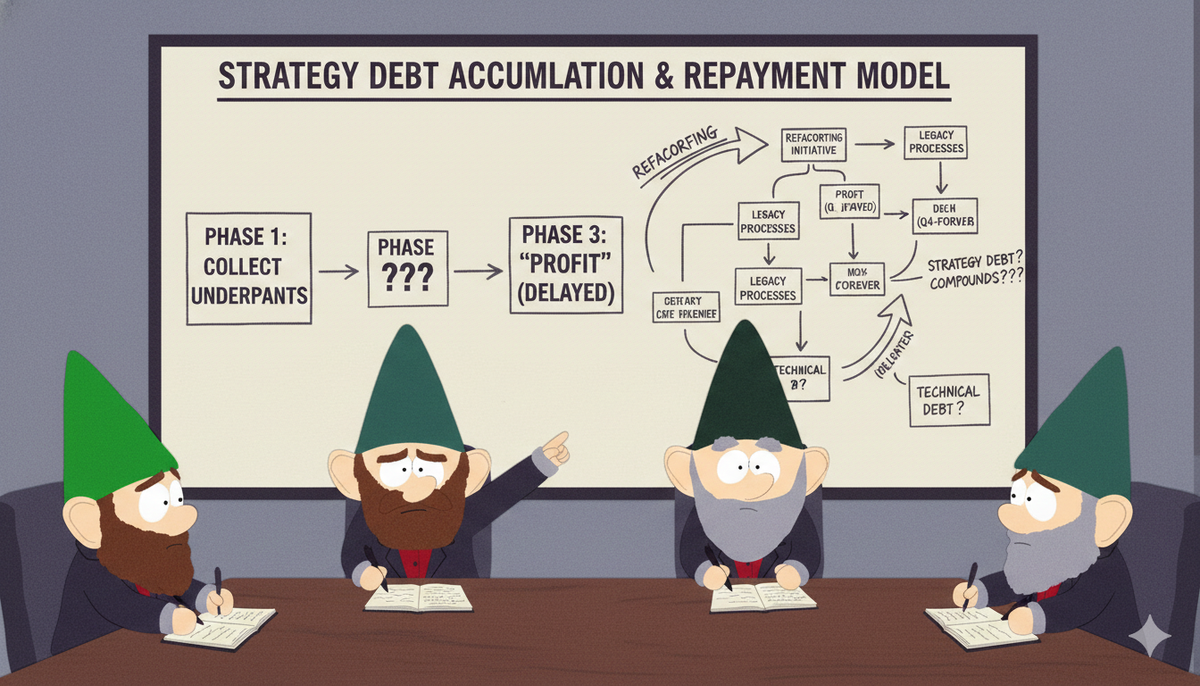
Every operator understands technical debt. You trade speed today for a mess tomorrow. If you don't pay it back, the system breaks.
Strategy debt is identical, but more expensive. It is the accumulation of past decisions that are no longer true, yet still dictate how your team spends their time. It is the project that was "top priority" six months ago and never officially died. It is the market pivot that changed the what, but never updated the why for the engineering team.
When strategy debt compounds, execution slows to a crawl. High-performing individuals become frustrated by "busy work" that leads nowhere. Decisions take longer because they must be reconciled against a ghost pile of legacy goals.
This is not a failure of vision. It is a failure of operational hygiene.
The Anatomy of Strategy Debt
Strategy debt does not happen because of bad intentions. It happens because of "and" instead of "or."
When a company is small, the strategy is in the founder’s head. Alignment is high because the surface area is low. As you scale, you add layers. Each layer interprets the strategy. When the market shifts—or the product evolves—leadership often adds new objectives without explicitly killing the old ones.
Common sources of strategy debt include:
- The Zombie Initiative: A project that lost its business case but still has a weekly sync and three dedicated engineers.
- The Unchecked Pivot: Changing the company direction but leaving the old KPIs in place for the sales team.
- The Consensus Tax: Maintaining legacy workflows because it's easier than having the difficult conversation required to stop them.
Why Strategy Debt Compounds
In finance, compound interest makes small sums grow. In operations, strategy debt makes small misalignments grow into organizational paralysis.
If Team A is optimized for a 2024 goal and Team B is optimized for a 2025 goal, the friction occurs at the interface. Cross-functional projects fail because the teams have different definitions of success. To fix this, leadership introduces "alignment meetings."
These meetings are a form of interest payment. You are spending your most valuable resource—time—to manage the debt rather than shipping product. Eventually, the interest payments consume 100% of your capacity. This is when a company feels like it is "busy but not moving."
Identifying the Symptoms
You cannot fix what you cannot see. Operators should look for these three red flags:
1. The "Why" Gap
Ask a mid-level manager why their current top priority matters to the company’s three-year goal. If they give you a historical explanation ("We’ve always tracked this") rather than a strategic one ("This unlocks X"), you have strategy debt.
2. Metric Proliferation
If your executive dashboard has 25 "Primary" KPIs, you have no strategy. You are simply measuring everything because you haven't decided what actually matters. Each metric requires a human to monitor, report, and care about it. That is overhead.
3. The "Priority 1" Paradox
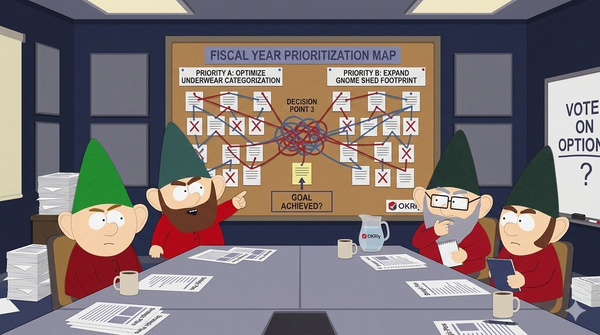
When everything is a Priority 1, nothing is. Strategy is the art of sacrifice. If your list of "stop-doing" items is empty, your strategy debt is likely at an all-time high.
How to Pay Down the Debt
Paying down strategy debt requires more than a new slide deck. It requires a "strategic audit" and the courage to kill work.
The Sunset Review
Every quarter, list every active initiative. For each one, ask: "If we weren't doing this today, would we start it?" If the answer is no, kill it immediately. Do not "wind it down." Do not "transition" it. Stop.
Hard-Coding the Trade-offs
A good strategy tells you what you are not doing. If your OKRs don't clearly state what is being sacrificed to achieve the objective, they are incomplete.
For example:
- Bad Objective: "Grow revenue while maintaining high NPS."
- Better Objective: "Maximize revenue growth, even if NPS dips by 5 points due to the new pricing model."
The second version pays down debt by removing the ambiguity of choice for the team.
The Rule of One
Force every department to have exactly one North Star metric. They can have supporting signals, but only one number determines if the quarter was a success. This forces the "and/or" conversation to happen at the start of the cycle, rather than in the middle of execution.
The Role of OKRs in Debt Management
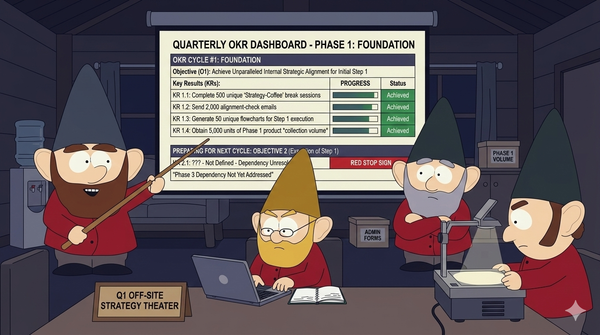
Most companies use OKRs as a tracking tool, which actually increases strategy debt. They use them to document everything they are doing.
Effective OKRs are a debt-clearing mechanism. They are the "clean" version of the strategy for the next 90 days. If an item doesn't fit into the OKR structure, it shouldn't exist in the calendar.
When you move from a "tracking" mindset to an "operating" mindset, OKRs become the filter. They prevent the accumulation of new debt by providing a high bar for what qualifies as a "priority."
Strategy Debt by Company Stage
The nature of this debt shifts as you grow.
- Seed/Series A: Debt is usually caused by "Founder Whim." The fix is a weekly cadence that grounds the founder in reality.
- Series B/C: Debt is caused by "Departmental Silos." The fix is cross-functional OKRs that force teams to agree on shared outcomes.
- Enterprise: Debt is "Institutional Habit." The fix is often a radical simplification of the product line or organizational structure.
Frequently Asked Questions
Is strategy debt the same as bad management?
Not necessarily. Strategy debt often comes from good management that is moving too fast. It's a byproduct of growth and change. The "bad management" part is failing to recognize and clean it up periodically.
How often should we "audit" our strategy debt?
Ideally, every quarter during your OKR planning. However, a "deep clean" should occur at least once a year, during which you review the business's fundamental assumptions and discard those that are no longer true.
Can you ever have zero strategy debt?
No. Just as with technical debt, some strategy debt is acceptable if it enables rapid testing. The goal isn't to be debt-free; it's to be "debt-aware" and ensure you aren't paying more in interest than youare saving in time.
Who is responsible for paying down strategy debt?
The COO or Head of Operations usually owns the process, but the CEO must provide the air cover to actually kill projects. Without the CEO's willingness to say "no," the audit is just a paper exercise.
How do I tell a team their project is "strategy debt"?
Be direct. Frame it as a shift in company constraints, not a failure of their work. Explain that the "market/context has changed" and their talents are now more urgently needed on a different frontier.
The most dangerous thing about strategy debt is that it is silent. You don't get an error message when your goals are misaligned; you just get a team that is tired and a roadmap that is stuck.
Applying a rigorous operating cadence is the only way to keep the debt in check. If you want to stop letting your strategy rot, you need a system that forces the "stop" as much as it celebrates the "start."
OKRly helps you identify and eliminate strategy debt by automating the weekly cadence and flagging misaligned objectives before they compound. Let AI handle the "interest payments" so your leadership team can focus on the next move.
FAQ
What are common signs of strategy debt?
Three telltale signs: the team maintains products or features that no longer serve the current strategy but "still have some users." New initiatives keep getting delayed because legacy commitments consume capacity. And every planning session starts with relitigating old decisions instead of making new ones. If any of these sound familiar, you have strategy debt.
How do you pay down strategy debt?
The same way you pay down technical debt — deliberately, with dedicated capacity. Identify the legacy commitments that no longer serve the strategy. Quantify how much capacity they consume. Then make an explicit decision to sunset, simplify, or transfer each one. This is painful because it means admitting that past decisions didn't age well. But carrying the debt is more expensive than paying it down.
How do you prevent strategy debt from accumulating?
Build sunset criteria into every new initiative at launch. "We'll continue this if X metric reaches Y by date Z. If not, we'll wind it down." This prevents initiatives from becoming permanent just because nobody made the call to end them. Strategy debt accumulates when decisions have start dates but no review dates.
Want to Learn More?
Strategy debt compounds silently. OKRly.ai makes your commitments visible and tracks them against outcomes, so you can spot the initiatives that are consuming capacity without delivering value — before they eat your next quarter.