Strategy Fails at the Edges, Not the Center
Strategy doesn't fail because the plan is bad; it fails because the "edges" of the organization—the people doing the daily work—lose context. Learn how to bridge the gap between executive intent and front-line execution.

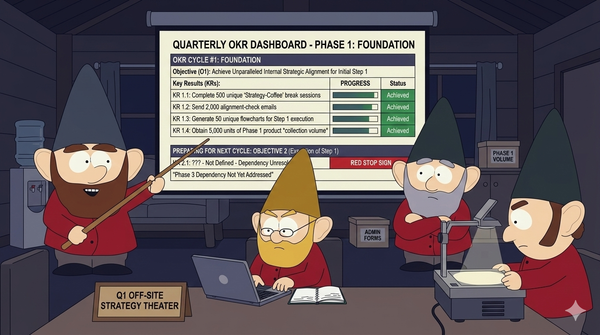
Most leaders believe strategy fails because the plan was wrong. They spend months debating market positioning and competitive moats. They emerge with a polished deck, a set of high-level OKRs, and a sense of accomplishment.
Then, six months later, the results don't manifest. The post-mortem usually blames "market shifts" or "lack of focus."
The reality is more boring and more dangerous. Strategy rarely fails at the center. It fails at the edges when the center becomes disconnected.
The "center" is the executive suite where the strategy is defined. The "edges" are the individual contributors and front-line managers making hundreds of small trade-off decisions every day. If the person writing the code, making the sales call, or triaging the support ticket doesn't understand how their 2:00 PM task connects to the 3-year vision, and the execs aren't communicating properly, the strategy is already dead.
The Illusion of Alignment
In most organizations, alignment is a game of telephone. The CEO tells the VPs, the VPs tell the Directors, and the Directors tell the Managers. By the time the message reaches the edge of the organization, the "why" has been stripped away, leaving only a "what."
This creates tactical drift. Tactical drift occurs when teams optimize for local metrics (e.g., shipping a feature on time) at the expense of global strategic intent (e.g., ensuring the feature actually solves the user's retention problem).
Alignment is not a one-time event. It is a continuous synchronization process. If you aren't synchronizing the center with the edges every single week, the gap between the plan and the reality will widen until it is unbridgeable.
The Cost of the Information Gap
Strategic failure is fundamentally an information problem.
At the center, you have high context but low detail. You know the "why," but you don't know the technical debt slowing down the sprint.
At the edge, you have high detail but low context. The engineer knows exactly why the database is slow, but they don't know that the company is pivoting away from that product line next quarter.
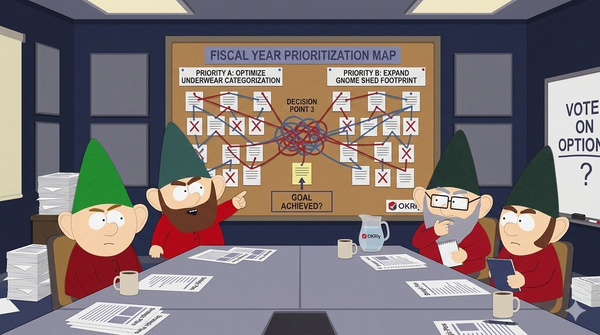
When these two groups don't share a common operating language—typically, OKRs—they end up making conflicting decisions. The center pushes for speed; the edge slows down for quality. Both are "right" in their own context, but the strategy fails because the effort is fragmented.
Edge Case: The "Hero" Manager
A common failure mode is the Hero Manager. This is the leader who tries to bridge the gap through sheer force of will. They attend every meeting, review every PR, and manually align every task.
This works for a team of five. It breaks at fifty.
The Hero Manager becomes a bottleneck. Because the strategy isn't embedded in the company's operating system, the "edges" become paralyzed whenever the manager isn't in the room to make a decision. To scale, the strategy must be decentralized. Every person at the edge must be empowered to make "on-strategy" decisions without seeking permission.
When Top-Down Becomes Bottom-Heavy
Strategy also fails when the center tries to over-prescribe the "how."
If the executive team dictates specific features rather than desired outcomes, they stifle the expertise of people at the edges. The people closest to the customer or the code are usually the best at coming up with ideas for achieving a goal.
When the strategy is too rigid, the edges stop thinking. They just execute orders. This creates a "compliance culture" rather than a "performance culture." In a fast-moving market, a compliance culture is a death sentence. The strategy cannot adapt to local realities because the feedback loop from the edge to the center is broken.
How Context Replaces Control
The fix isn't more control; it’s more context.
Operators need to move away from "tracking" and toward "operating." Tracking involves reviewing a dashboard once a month to see whether a number is red or green. Operating is the daily act of ensuring that the work being done is the work that matters.
This requires a radical transparency of intent.
- Why are we doing this?
- What happens if we fail?
- What are we explicitly not doing to make room for this?
If your OKRs are sitting in a spreadsheet that no one looks at, you haven't provided context. You've provided homework.
Why Teams Get This Wrong in Practice
Most teams treat OKRs as a reporting mechanism for leadership. This is a mistake. OKRs are for the teams at the edges.
If the team doesn't use the OKR to decide what to do on Tuesday morning, the OKR is useless. The most common failure mode is the "Set and Forget." You set the goals in January and check them in March. By February, the team at the edge has already encountered three obstacles that weren't in the plan. Without a mechanism to adjust the tactics while keeping the objective, they revert to "business as usual."
Strategy by Company Stage
The "edge" problem changes as you grow:
- Seed/Series A: The edge is only one layer away from the center. Alignment is easy; focus is the problem.
- Series B/C: This is the danger zone. Layers are added. The founders can no longer talk to everyone. If a formal operating system isn't implemented here, the strategy will fail at the edges immediately.
- Enterprise: The edges are so far from the center that they might as well be in different companies. Strategy here is about creating small, autonomous units with high strategic context.
FAQ
What is the "edge" in business strategy? The edge refers to the front-line employees and managers who interact with customers, write code, and execute daily tasks. They are where the strategy meets the reality of the market.
How do I know if my strategy is failing at the edges? Look for "busy-work" that doesn't move the needle, frequent mid-quarter pivots, or a disconnect between what the CEO says is important and what the engineers are actually working on.
Can AI help with strategic alignment? Yes. AI can act as a "Chief of Staff" that constantly connects individual tasks to high-level objectives, surfacing misalignments in real-time before they become catastrophic failures.
Fix Your Execution
Strategy is just a hypothesis until it hits the edge of your organization. Most companies fail because they lack the tooling to turn that hypothesis into a daily reality for every employee. OKRly.ai acts as your AI Chief of Staff, ensuring the center's intent is always present at the edges.
Stop managing spreadsheets and start running your company. See how AI automates aligning your strategy and execution.
Want to Learn More?
Strategy fails where headquarters meets reality. OKRly.ai connects company-level objectives to team-level key results, so the strategic intent survives its journey from the boardroom to the front lines.