The Danger of Over-Explaining Strategy
When leaders over-explain strategy, they create noise instead of clarity. Learn why explanation is often the enemy of execution — and what disciplined strategy communication looks like for operators.

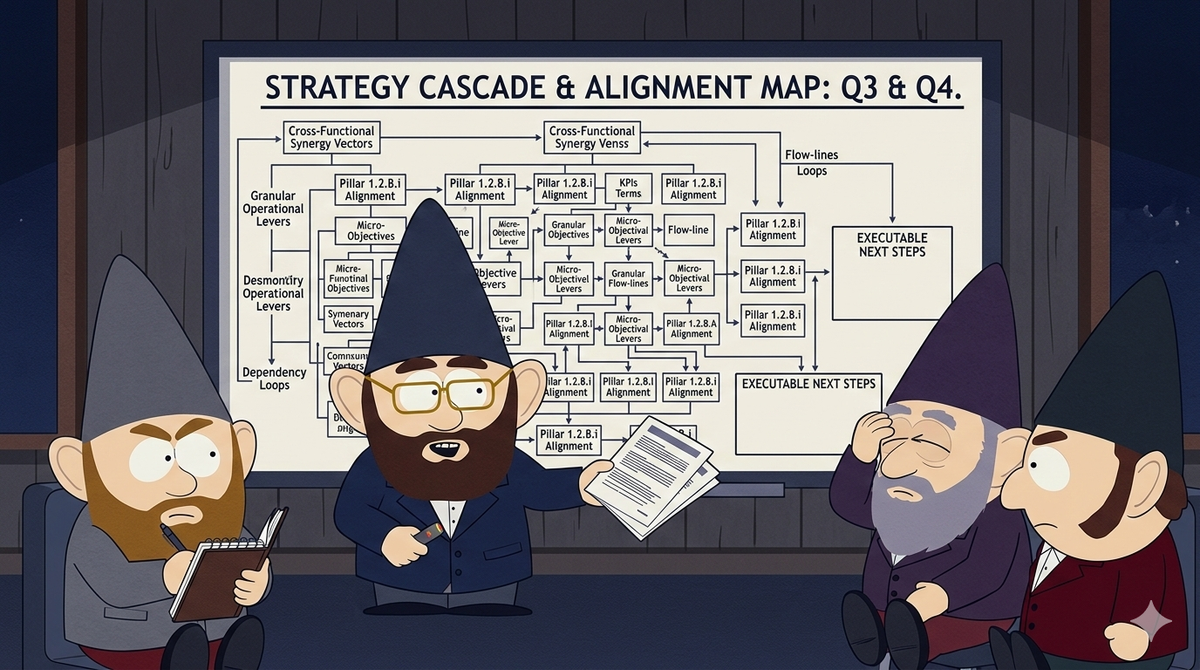
There is a version of strategy communication that looks like thoroughness but functions like noise. The leader who spends forty-five minutes walking through the rationale for every strategic choice, the all-hands deck that explains the market forces, the competitive dynamics, the four alternative paths considered, the reasons each was rejected — it feels responsible. It feels like respect for the team's intelligence. And it is, slowly, quietly, making your strategy harder to execute.
When leaders over-explain strategy, they are usually solving for their own anxiety, not for their team's clarity. The explanation becomes a defense mechanism: if everyone understands why we made this choice, they can't push back. If I show my work, they'll trust the output. But this is exactly backwards. The more reasoning you front-load, the more entry points you create for debate. And in most organizations, debate at the strategy level is the enemy of execution.
The Difference Between Context and Explanation
There is a meaningful distinction between giving your team context and explaining your strategy. Context answers: "What's changing, and what does that mean for how we operate?" Explanation answers: "Here is every factor we weighed and why we landed here." The first is useful. The second is usually a meeting you don't need to have.
A mid-level manager who understands that the company is prioritizing enterprise over SMB this quarter has what they need to make dozens of daily decisions differently. They don't need to know the gross margin analysis behind that call or the three enterprise deals that shifted leadership's view. The context is operational. The explanation is historical. Only one of them helps someone do their job better tomorrow morning.
The trap is that explanation feels more respectful. It feels like you're treating your team as intelligent adults. And they are intelligent adults — which is exactly why they don't need a lecture to act on a clear direction.
What Over-Explanation Actually Signals
When leaders feel the urge to over-explain strategy, it is almost always one of three things:
Uncertainty about the decision itself. If you're not fully confident in the direction, you compensate by burying it in rationale. The reasoning is designed to convince yourself as much as your team. The tell: the explanation is longer than the decision.
Anticipating resistance. If you know the strategy will be unpopular, you pre-load objection handling into the communication. You address every likely pushback before it's raised. This rarely works. People who have concerns still raise them, just after sitting through twenty minutes of context they didn't ask for.
Conflating communication with alignment. Many leaders believe that if they explain the strategy thoroughly enough, alignment will follow. It won't. Alignment comes from repeated exposure to a clear direction, not from a single thorough explanation. You cannot explain your way to alignment. You have to earn it through consistency over time.
The Cost You're Not Measuring
Over-explaining strategy has costs that almost never show up in a retrospective but compound quietly over months:
Decision fatigue at the middle layer. When your managers feel like every strategic shift comes with a seminar, they start dreading communication from leadership. They tune out. The ratio of content to signal becomes too low, and they stop listening for the actual direction buried in the explanation.
Permission to debate instead of execute. Detailed explanation invites detailed response. When you lay out the four paths you considered, you are implicitly signaling that the decision space is still open. People relitigate. They have opinions about path three. They think you dismissed option B too quickly. What was meant as transparency becomes an invitation to reopen the question.
Narrative drift. The more words you use to describe a strategy, the more surface area there is for misinterpretation. Every extra sentence is a sentence someone will remember slightly wrong, synthesize differently, or use to justify a decision that doesn't align with your intent. Lean, specific strategy communication is harder to misquote.
What Disciplined Strategy Communication Looks Like
The leaders who are best at this share a few habits. They separate the decision from the rationale, and they share those things in different channels at different times. The decision goes broad, immediately, in the clearest language possible. The rationale is available for those who want it — a document, a follow-up session, a note — but it does not block the decision from landing.
They also have a rule about length: if you can't state the strategic priority in two sentences, you don't understand it well enough yet. This is not a communication technique. It is a thinking discipline. The compression required to get to two sentences forces a clarity that most strategy documents never achieve.
And they distinguish between one-time explanation and ongoing reinforcement. A strategy doesn't land because you explained it once, even brilliantly. It lands because it shows up in every priority call, every resource decision, every "no" you say to a good idea that doesn't fit. Repeated, consistent signal beats a single comprehensive briefing every time.
When to Explain More, Not Less
This is not an argument for opacity. There are moments when explanation is exactly right. When a strategic direction is a significant departure from what came before, people need more than a direction — they need enough context to update their mental model of how the business works. When key people are being asked to make a sacrifice (slower growth in their area, fewer resources, a structural change), they deserve to understand why. When your strategy depends on discretionary effort from people who could choose to phone it in, the why matters.
The discipline is knowing which situation you're in. Most strategy communication happens in the first category — routine updates, quarterly priorities, cascade from leadership — where the reflex to explain is doing more harm than good. Reserve depth for the moments where it genuinely changes how people show up, not as a default mode for every strategic conversation.
FAQ
How do I know if I'm over-explaining?
A reliable signal: if your strategy communication regularly runs longer than ten minutes to deliver and people are still asking clarifying questions afterward, the explanation isn't adding clarity — it's creating it. Another signal is that people quote your rationale back to you instead of your direction. They absorbed the reasoning but not the decision.
What if my team pushes back on decisions they don't understand?
Some pushback is healthy and worth engaging. But if you're consistently managing challenge to strategic decisions, the problem is rarely that you haven't explained enough. It's more often that direction isn't being reinforced consistently between communication moments, or that the strategic logic shifts frequently enough that people have learned to question rather than act.
How do you build trust without showing your reasoning?
Trust in leadership strategy comes from track record, not from transparency about process. People trust leaders who call it right, who follow through, and who acknowledge when a direction didn't work out. A leader who shares every nuance of their reasoning but makes poor decisions does not earn trust. Show your work through outcomes, not through explanation.
Is there a format that works better for strategy communication?
Yes: direction first, context second, detail available on request. Lead with what you've decided and what it means for the team. Follow with the one or two pieces of context that change how people should interpret their own work. Make the full reasoning available in writing for anyone who wants it, and then stop talking. The format respects both clarity and intelligence.
Strategy is most powerful when it's simple enough to repeat without a slide deck. If your team can't describe the direction in their own words — without referencing your explanation — the communication has failed regardless of how thorough it was. OKRly.ai helps operators keep strategic priorities visible and specific so that the direction does the work, not the deck.
Want to Learn More?
When strategy needs a decoder ring, it's not strategy — it's theater. OKRly.ai helps you translate strategic intent into clear, trackable OKRs that every team can act on without a 40-page brief.