The Difference Between Knowing the Goal and Knowing the Work
Setting goals is easy; designing the work to hit them is hard. Learn why most teams fail at execution by confusing strategic intent with operational reality, and how to build a causal link between your weekly tasks and your quarterly OKRs.

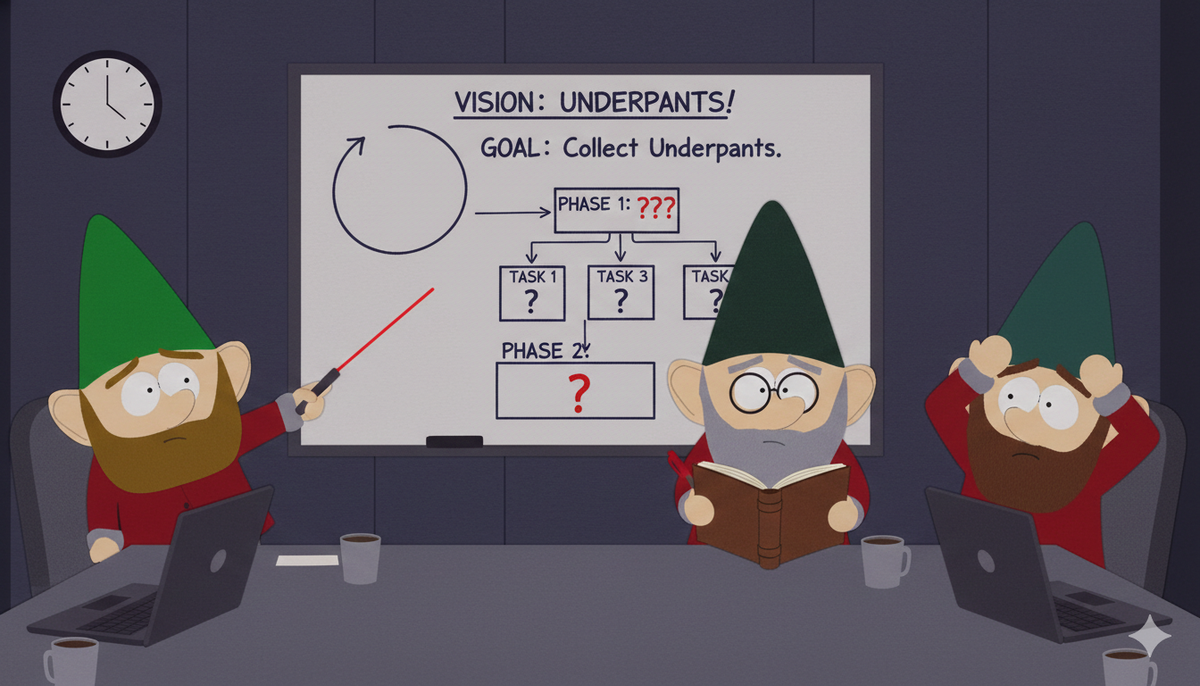
Most companies fail at OKRs not because they pick the wrong goals, but because they don't understand the work required to hit them. There is a fundamental difference between strategic intent and operational reality.
In management theory, "knowing the goal" is often treated as the finish line for leadership. In reality, setting the goal is only about 5% of the effort. The remaining 95% is the design and maintenance of the work loops that turn that goal into a result.
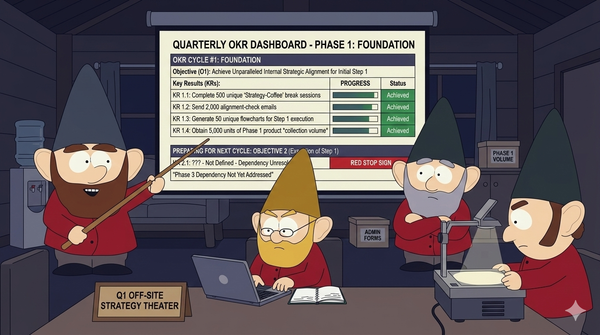
If you are a COO or Chief of Staff, you’ve seen this happen: a team sets an ambitious Objective to "Dominate the Mid-Market Segment." They agree on Key Results like "$2M in new ARR." Then, three months later, they’ve missed the target by 40%. When you dig in, the team was busy—they were working—but the work they chose had no causal link to the goal.
Knowing the goal is a choice. Knowing the work is a craft.
The Illusion of Alignment
Alignment is the most overused word in corporate strategy. Most leaders think alignment means everyone has read the same slide deck.
True operational alignment means that if I stop any individual contributor on a Tuesday afternoon and ask why they are doing their current task, they can trace a direct, logical line to a Key Result.
When teams "know the goal" but not the work:
- Activity increases while progress stalls: The team is "busy" but the needle doesn't move.
- Updates become narratives: Weekly reports focus on "we did X and Y" instead of "we moved the metric by Z because of X."
- The "End-of-Quarter Surprise" occurs: No one realizes the goal is at risk until week 10.
Bridging the Gap: The Causal Link
To move from goal-setting to execution, you must force the team to define the causal link.
If the goal is to reduce churn by 10%, "knowing the work" means identifying the specific levers that influence churn. Is it the onboarding flow? Is it the response time for support tickets? Is it a specific bug in the billing system?
You haven't defined the work until you have identified the leading indicators.
Leading Indicators vs. Lagging Results
A common failure mode in OKRs is setting Key Results that are entirely lagging indicators. Revenue, churn, and NPS are lagging. By the time you measure them, the work that produced them is already done. You can't "do" revenue. You can only do things that generate revenue.
Knowing the work means shifting focus to leading indicators:
- Lagging: $1M in Pipeline.
- Leading: 50 outbound discovery calls per week.
- The Work: Identifying 200 high-intent leads and writing 5 personalized sequences.
Operators who excel at execution obsess over the third point. They manage the inputs, knowing that the outputs are a mathematical consequence of them.
Failure Modes: Why Teams Get This Wrong
Even with the best intentions, teams often drift away from the work that matters. Here are the most common reasons why:
1. The "Business as Usual" Trap
Teams often set OKRs and then continue doing their previous "business as usual" (BAU) tasks. They view OKRs as an "extra" thing to do on Friday afternoons. If the work required for the OKR doesn't take up 80% of their daily calendar, the OKR will fail.
2. Lack of Granularity
"Improve the product" is a goal. "Refactor the checkout API to reduce latency by 200ms" is work. Most teams stay at the goal level because the work level is hard and requires technical or operational trade-offs they aren't ready to make.
3. The Feedback Loop is Too Long
If the goal is annual and the team only checks progress monthly, they have only 12 chances to correct course. By the time they realize the work isn't working, a quarter of the year has gone by.
Execution at Different Stages
The relationship between the goal and the work changes as a company scales:
- Seed to Series A: The work is pure discovery. The goal is "Validation." The work is 50 customer interviews. You don't know the work yet; you are working to find the work.
- Series B to C: The work is about scale and efficiency. The goals are predictable. You know the work—now you need to optimize the cost of that work.
- Enterprise: The work is about alignment across silos. The danger here is "Work for the sake of work," where the bureaucracy of the process masks a total lack of progress toward the goal.
The COO’s Role: Designing the Cadence
An operator's job is to build the machine that does the work. This is the Operating Cadence.
A high-performance cadence consists of:
- Annual Strategy: The North Star.
- Quarterly OKRs: The seasonal focus.
- Weekly Check-ins: The "Work" level. This is where you ask: "Did the work we did last week move the leading indicators? If not, why are we doing the same work this week?"
If you aren't changing the work based on the data from the previous week, you aren't executing; you're just following a script.
Trade-offs: Quality vs. Velocity
Knowing the work requires making uncomfortable trade-offs. You cannot do everything.
If the work required to hit a goal is 60 hours a week and your team has 40, you have two choices: change the goal or change the work. Most leaders do neither and just "hope" it gets done. Hope is not an operating strategy.
Effective operators choose velocity over perfection. It is better to do the wrong work quickly, realize it’s wrong, and pivot than to spend a month debating the "perfect" work while the metric stays flat.
Why Teams Get This Wrong in Practice
Teams fail because they treat OKRs as a reporting requirement rather than a navigation tool.
When OKRs are viewed as a "grade" at the end of the quarter, teams sandbag their goals. When OKRs are viewed as a map for the work, teams are honest about where they are lost.
As a leader, you must reward the team that admits "The work we planned is not moving the goal" more than the team that hits a fake goal through luck.
FAQs
How do I know if my Key Results are leading or lagging? Ask yourself: "Can the team influence this number directly in the next 7 days?" If the answer is no, it’s likely a lagging indicator. "Close 3 deals" is lagging. "Send 20 proposals" is leading.
What should I do if the work isn't moving the goal? Stop. Do not wait for the end of the quarter. Re-evaluate the causal link. If you believed that increasing blog traffic would increase signups, and traffic is up but signups are flat, your hypothesis was wrong. Change the work to focus on conversion rate optimization instead of more traffic.
How much time should the team spend on OKR-related work? For most growth-stage companies, OKR-aligned work should represent 60–80% of total capacity. The remaining 20–40% is "keeping the lights on." If OKRs are only 10% of the work, they aren't the priority; they are a distraction.
Who is responsible for defining "the work"? The Objective is set by leadership (the "What" and "Why"). The Key Results and the specific Work (the "How") should be defined by the team executing them. They are closest to the friction and most qualified to identify the levers.
If you find yourself spending more time tracking progress in spreadsheets than actually doing the work, your process is broken. Execution shouldn't be a manual chore. OKRly.ai automates the weekly cadence by using AI to bridge the gap between your high-level goals and the daily work your team actually does.
Stop managing the tracker and start managing the execution. Let AI handle the follow-ups and status updates at OKRly.ai so you can focus on the work that moves the needle.
FAQ
Whose job is it to translate goals into work?
The team lead or manager closest to the execution. Senior leadership sets the objective. The team closest to the work determines what specific actions will achieve it. The gap between goal and work should be bridged by the people who understand both the strategic intent and the operational reality. If leadership is dictating the work, they're micromanaging. If the team can't connect their work to the goal, there's a translation failure.
How detailed should the "work" be when setting OKRs?
Key results should describe measurable outcomes, not detailed task lists. "Reduce onboarding drop-off from 40% to 20%" is the right level. The specific features, experiments, and sprints needed to get there are the team's domain. OKRs set the destination. Sprint planning maps the route.
What happens when the work doesn't move the goal?
That's a signal, not a failure. If the team executed the planned work and the key result didn't move, the hypothesis was wrong — not the team. The right response is to learn from it and try a different approach, not to blame execution. This is why outcome-based key results are valuable: they create a feedback loop between effort and impact that task-based goals never provide.
Want to Learn More?
Knowing the goal isn't the same as knowing the work. OKRly.ai bridges that gap with OKRs that connect company objectives to team-level key results, so every team knows both where they're going and what to do next.