Why Alignment Meetings Rarely Produce Alignment
You can tell an organization is misaligned by how many meetings have 'alignment' in the title. If alignment could be achieved by sitting in a room together, your company would be the most aligned organization on earth.

Something feels off between the teams. Priorities seem to conflict. People are working on things that don't connect. So someone schedules an "alignment meeting." An hour later, everyone leaves saying, "Great, we're aligned." Two weeks later, the same conflicts resurface. Because the meeting didn't produce alignment. It produced the feeling of alignment. Those are not the same thing.
Alignment Meetings Align on Vibes, Not Commitments
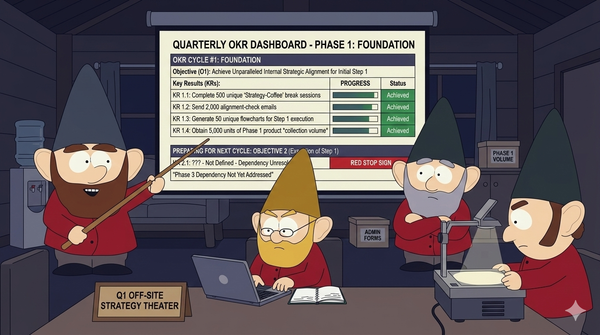
Most alignment meetings follow a predictable script. Each team presents what they're working on. People nod. Someone says, "That makes sense." A few questions get asked. The meeting ends with no explicit commitments, no documented trade-offs, and no mechanism to check whether alignment holds past Tuesday.
The problem is structural. Alignment meetings are designed as information-sharing sessions. Everyone hears what other teams are doing. This creates a sense of awareness that gets mistaken for alignment. But awareness isn't alignment. Alignment means teams are making coordinated decisions that reinforce a shared priority. You can be fully aware of what another team is doing and still be pulling in a completely different strategic direction.
The tell is what happens after the meeting. If two teams walk out of an alignment meeting and make contradictory decisions the following week, they were never aligned. They just sat in the same room.
Why the Meeting Format Prevents Real Alignment
Real alignment requires three things: a shared priority, agreed-upon trade-offs, and a commitment that can be checked. The typical alignment meeting provides none of these.
There's no shared priority because the meeting is structured around team updates rather than company objectives. Each team presents its world. Nobody maps those updates against a single shared goal and asks, "Are all of these moving us in the same direction?" Without that question, the meeting is parallel presentations, not alignment.
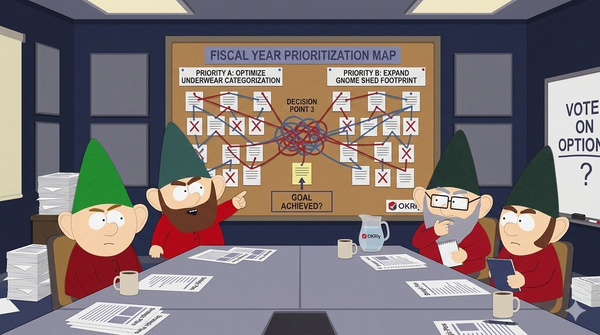
There are no trade-offs because nobody wants to be the person who says, "Your priority conflicts with ours, and one of us needs to give." Alignment meetings are consensus-driven by default. The unspoken rule is that we leave the room without anyone feeling like they lost. But alignment often requires someone to change their plan, and polite consensus prevents that conversation.
There are no checkable commitments because the meeting ends with "Great, let's stay in sync" instead of "Here are the three things we agreed to, and here's when we'll check." Without specific, documented agreements, there's nothing to hold anyone to. The alignment dissolves the moment someone's context changes.
What Produces Actual Alignment
Replace alignment meetings with alignment artifacts. Instead of a meeting where people talk about what they're doing, create a one-page document that answers three questions: What is the single most important company objective this quarter? How does each team's top priority support that objective? Where do team priorities conflict, and how have we resolved those conflicts?
This document does the work that a meeting can't. It forces teams to map their work to a shared goal. It makes conflicts visible on paper instead of hiding them behind polite nods. And it creates a reference point that anyone can check when a new decision arises: "Does this align with what we agreed to?"
When you do need a meeting, make it a conflict-resolution session, not an information-sharing session. Before the meeting, each team identifies where their plans conflict with another team's. The meeting's sole purpose is to resolve those conflicts. No presentations. No updates. Just decisions.
After any alignment conversation, document three things: what was decided, who committed to what, and when you'll check. If you can't fill in all three, alignment didn't happen. Go back and finish the conversation.
The Alignment Audit
Ask each team lead on your leadership team to independently answer this question: "What is the company's number one priority this quarter, and how does your team's top initiative support it?"
Compare the answers. If you get the same company priority from everyone, you have shared awareness. If every team's initiative clearly connects to that priority, you have real alignment. If you get different company priorities or team initiatives that don't obviously connect, you have the appearance of alignment without the substance.
This test takes 15 minutes and reveals more about your organization's alignment than a month of meetings. Run it before your next quarterly planning cycle. If the answers diverge, that's where the real alignment conversation needs to happen — not in a room where everyone presents their slides and nods.
FAQ
If alignment meetings don't work, how do teams stay in sync?
Through shared objectives, visible progress tracking, and conflict-resolution conversations when needed. If every team is working toward the same company objective and progress is tracked in a shared system, alignment happens through the work itself. Meetings should be held only when conflicts arise — and those meetings should focus exclusively on resolving the conflict, not on sharing general updates.
How do you align teams in a remote or hybrid environment?
Alignment artifacts are even more important remotely. A shared document that maps team priorities to company objectives is accessible anytime, in any timezone. Async updates replace the information-sharing part of alignment meetings. Synchronous time should be reserved exclusively for resolving conflicts and making decisions that require real-time discussion. More documents, fewer meetings, more alignment.
How often should teams check alignment?
Alignment should be checked whenever a significant decision is made, not on a fixed calendar. Monthly alignment meetings create the illusion of regular calibration while missing the actual moments when alignment breaks— moments that happen between meetings. Instead, create a trigger: whenever a team's plan changes materially, they check their alignment artifact and flag any conflicts. This is event-driven alignment, and it catches problems when they happen rather than weeks later.
Want to Learn More?
Alignment isn't a meeting — it's a shared understanding that holds up under pressure. OKRly.ai makes your company's objectives visible to every team, tracks how team-level key results connect to company goals, and surfaces misalignments before they turn into a quarterly fire drill.